PVC Flex Banner Material for Printing and Display Applications
PVC Flex Banner Material is a printable composite made with polyester textile and flexible PVC layers. It is widely used for signs, advertising graphics, exhibitions, event displays, and illuminated graphics.
MSD develops hot and cold laminated banner, coated banner, coated blockout banner, and translucent PVC material. Each structure differs in printing surface, textile reinforcement, optical performance, and finishing compatibility.
Finished performance also depends on ink, curing, seams, hems, eyelets, frames, lighting, installation, and outdoor exposure.
What Is PVC Flex Banner Material?
PVC flex banner combines a polyester textile with flexible PVC layers. The textile provides reinforcement and dimensional support, while the PVC surface supports printing, welding, water resistance, and visual finishing.
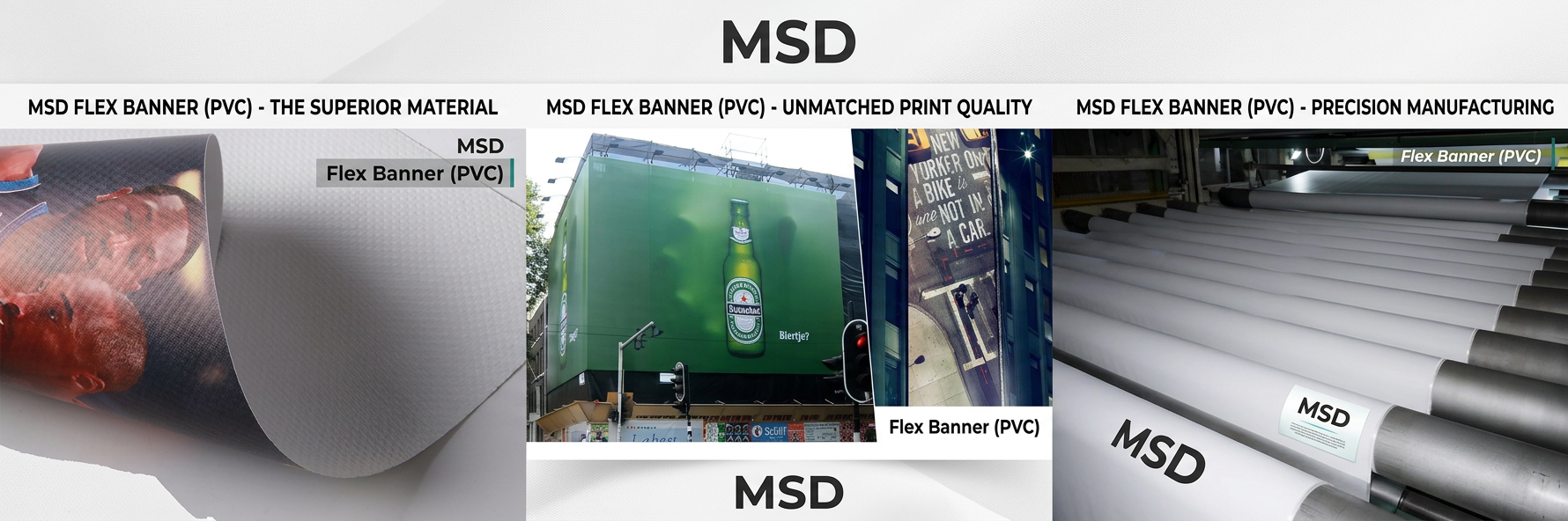
Typical constructions may include:
- Polyester reinforcing textile
- Single- or double-sided PVC layers
- Bonding interfaces
- Printable surface treatment
- Opaque or translucent layers
Common terms include PVC banner material, coated banner, laminated banner, frontlit banner, blockout banner, black-back banner, and translucent PVC material. These names may represent different textile densities, PVC formulations, weights, and optical properties.
What Functions Does PVC Flex Banner Provide?
Depending on its structure, PVC flex banner can provide:
- Printable graphic surfaces
- Flexible roll handling
- Textile reinforcement
- Water-resistant surfaces
- Thermal joining compatibility
- Opacity or controlled light transmission
- Support for hems and eyelets
- Indoor or outdoor display use
Performance should always be confirmed for the selected material grade.
How Is PVC Flex Banner Structured?
PVC flex banner is a multilayer material. Its performance comes from the combined textile, PVC layers, bonding interface, printable surface, and optical construction.
| Structural Element |
Main Function |
Key Check |
| Polyester textile |
Reinforcement |
Density, tensile and tear response |
| PVC layers |
Flexible exterior |
Thickness, coverage and flexibility |
| Bonding interface |
Connects the layers |
Peel adhesion |
| Printable surface |
Receives ink |
Ink adhesion and image quality |
| Optical layer |
Controls light |
Opacity or transmission |
| Finished edge |
Transfers loads |
Hems, eyelets and reinforcement |
Polyester Textile Reinforcement
Yarn denier, textile density, fabric direction, tensile response, tear behavior, and dimensional stability all influence banner performance. Warp and weft values may differ.
Textile strength alone does not define the wind resistance of an installed sign. Panel size, frames, seams, eyelets, attachment spacing, and tension are also important.
Flexible PVC Layers
PVC layers influence smoothness, whiteness, opacity, flexibility, water resistance, welding response, texture, and gloss. More PVC or greater thickness does not automatically mean better performance.
Bonding Interface
Layer adhesion depends on textile preparation, PVC chemistry, coating or lamination conditions, heat, moisture, and repeated flexing. Peel data should include the test direction, speed, angle, conditioning, and failure mode.
Printable Surface
The outer surface affects ink wetting, adhesion, color, definition, gloss, curing, abrasion, and blocking. Printing trials should use the intended ink, equipment, curing settings, and image coverage.
Main Types of PVC Flex Banner Material
MSD materials can be classified by manufacturing process or display function.
PVC Hot and Cold Laminated Banner
Laminated banner joins preformed PVC films with polyester reinforcement. Hot lamination uses controlled heat and pressure, while cold lamination uses a compatible bonding system at lower temperatures.
Important factors include film thickness, textile construction, adhesion, flatness, curling, and print response.
PVC Coated Banner
Coated banner is produced by applying a PVC formulation directly to the textile. Evaluation normally covers coating uniformity, textile coverage, flexibility, adhesion, printing, welding, and weathering response.
PVC Coated Blockout Banner
Blockout banner contains an opaque layer that limits light transmission and reverse-side show-through. It is suitable for double-sided graphics, hanging signs, exhibition panels, and displays installed over uneven backgrounds.
Key properties include opacity, flatness, curling, layer balance, and two-sided print compatibility.
PVC Translucent Material
Translucent PVC material allows controlled light to pass through while diffusing it. It is used for illuminated displays where transmission, color consistency, print density, and lighting uniformity matter.
Translucent material is not the same as transparent film.
Laminated Banner vs. Coated Banner
The main difference is how the PVC layer is integrated with the textile.
| Feature |
Laminated Banner |
Coated Banner |
| Layer formation |
PVC films joined to textile |
PVC applied directly to the textile |
| Main controls |
Heat, pressure and bonding |
Formulation, coating and curing |
| Main checks |
Flatness, curling and adhesion |
Uniformity, flexibility and adhesion |
Manufacturing method alone does not define suitability. Printing, finishing, textile design, and exposure conditions remain important.
Frontlit, Blockout and Translucent Display Functions
These terms describe how the material interacts with light.
| Display Type |
Function |
Evaluation Focus |
| Frontlit banner |
Viewed under front lighting |
Whiteness, gloss and image quality |
| Blockout banner |
Limits light and show-through |
Opacity and layer balance |
| Translucent material |
Transmits and diffuses backlight |
Transmission and uniformity |
Frontlit Banner
Frontlit banner is used under ambient or front-directed lighting. Important properties include whiteness, color consistency, ink compatibility, gloss, flatness, and image definition.
Blockout Banner
Blockout banner separates graphics from the background or opposite printed side. Opacity, curling, printability, and layer symmetry should be checked.
Translucent Display Material
Translucent material is designed for backlit graphics. Final appearance depends on the material, ink density, light source, lightbox depth, illumination spacing, and viewing distance.
Understanding PVC Banner Specifications
Banner specifications commonly include yarn denier, textile density, area weight, thickness, and width.
Yarn Denier
A value such as 500D × 500D describes nominal yarn size in two textile directions. It does not independently determine finished-banner strength.
Textile Density
Values such as 28 × 28 describe yarn density. The measurement unit and warp-to-weft sequence should be stated before comparing materials.
Area Weight
Area weight, expressed in gsm, affects handling, printing, folding, welding, transportation, and installation. Higher gsm does not always mean higher strength.
Thickness
Thickness can influence flexibility, roll handling, welding, and edge finishing. It should not be used alone to judge strength, opacity, or print quality.
Width
Usable width affects graphic layout, printing efficiency, seam quantity, material use, and installation planning.
How Is PVC Flex Banner Manufactured?
Production normally includes textile preparation, PVC formulation or film preparation, coating or lamination, surface treatment, stabilization, winding, and inspection.
Textile Preparation
The textile is checked for width, density, tension, cleanliness, moisture, flatness, and edge quality. Contamination or unstable tension can cause poor adhesion, wrinkles, or dimensional variation.
PVC Formulation or Film Preparation
Flexible PVC may contain resin, plasticizers, pigments, stabilizers, processing aids, and surface modifiers. The formulation affects flexibility, color, welding, printing, heat response, and storage behavior.
Coating or Lamination
Temperature, pressure, coating quantity, film thickness, speed, textile tension, cooling, and curing are controlled to maintain uniform layers and reliable adhesion.
Printable-Surface Treatment
Surface treatment may improve ink wetting, adhesion, image definition, gloss, and curing. Its performance can change with storage and environmental exposure.
Stabilization and Winding
Cooling, stabilization, and controlled winding help manage flatness, residual stress, curling, roll alignment, and surface marks.
Roll Inspection
Inspection may cover width, thickness, area weight, surface appearance, color, adhesion, pinholes, wrinkles, edges, and roll geometry.
Printing Performance
Printing results depend on the banner surface, ink, printer, curing method, graphic coverage, and production environment.
Print Compatibility
Applicable materials may support solvent, eco-solvent, UV-curable, latex, or screen printing. Compatibility should be confirmed with representative trials.
Image Quality
Evaluation may include color, detail, dot reproduction, ink coverage, banding, curing, and visual consistency. Large solid areas often reveal issues that small test images miss.
Ink Adhesion
Printed samples may be checked after drying, abrasion, folding, water exposure, cleaning, weathering, and blocking.
Printing on Blockout Materials
Two-sided printing requires suitable opacity, surface balance, graphic alignment, curing, and curl control.
Printing on Translucent Materials
Translucent graphics should be viewed under both reflected and transmitted light. Ink density, color profile, light source, and graphic coverage influence the result.
Optical and Display Performance
Optical properties affect appearance under natural, front-directed, or rear lighting.
Whiteness and Color Consistency
Consistent whiteness supports stable color across large or multi-panel graphics.
Gloss and Glare
Gloss changes reflected light and perceived color. The appropriate finish depends on lighting, viewing distance, and display location.
Opacity
Opacity limits light transmission and background visibility. It is especially important for blockout and double-sided graphics.
Light Transmission and Diffusion
Transmission measures how much light passes through the material. Diffusion describes how evenly that light is distributed.
Pinholes and Surface Uniformity
Pinholes and thin areas may become visible under backlighting. Inspection should reproduce the intended display conditions.
Converting and Finishing Methods
Printed banner materials often require cutting, joining, hemming, eyelets, reinforcement, or frame attachment.
Cutting
Cutting plans should consider material direction, registration, usable width, seam allowance, hem allowance, and dimensional response.
Thermal Welding
Compatible PVC banners may support high-frequency, hot-air, or hot-wedge welding. Temperature, pressure, speed, seam width, cooling, and printed areas require validation.
Sewing
Needle size, thread, stitch density, seam allowance, edge distance, and reinforcement affect sewn-seam performance.
Hemming
Folded, welded, sewn, reinforced, or taped hems can strengthen edges and distribute attachment loads.
Eyelets and Attachment Hardware
Eyelet size, spacing, edge distance, reinforcement, panel dimensions, frame design, and wind exposure should be considered together.
Applications of PVC Flex Banner Material
PVC flex banner can be used in a variety of printed display systems.
Advertising Signs
Suitable applications include promotional graphics, information panels, signs, and visual displays.
Building and Fence Graphics
Large-format graphics require careful planning of seams, reinforcement, wind exposure, attachments, drainage, and supporting structures.
Event and Exhibition Displays
These applications may prioritize print quality, portability, repeated setup, frame compatibility, and clean edge finishing.
Frontlit Displays
Frontlit applications require suitable whiteness, flatness, gloss, and print response.
Double-Sided Displays
Blockout materials help separate graphics printed on opposite sides.
Illuminated Displays
Translucent materials can support lightbox graphics when transmission, diffusion, ink density, lighting, and installation tension are properly coordinated.
How to Select PVC Flex Banner Material
Selection should connect material structure with printing, finishing, lighting, and installation.
1. Define the Display Method
Confirm whether the graphic is frontlit, backlit, single-sided, double-sided, blockout, or translucent.
2. Select the Material Structure
Choose between laminated, coated, blockout, or translucent construction.
3. Confirm the Printing System
Define the printer, ink, curing method, speed, coverage, and production environment.
4. Review Textile Specifications
Check yarn denier, textile density, material direction, tensile response, tear behavior, and dimensional stability.
5. Define Area Weight and Thickness
Balance handling, printing, welding, hanging, transportation, and installation needs.
6. Establish Optical Requirements
Specify whiteness, opacity, transmission, diffusion, gloss, and day-to-night appearance.
7. Confirm Finishing Methods
Review cutting, welding, sewing, hems, eyelets, reinforcement, seams, and frame attachment.
8. Evaluate the Installation Environment
Consider sunlight, rain, humidity, temperature, wind, display period, maintenance, and supporting structure.
9. Produce a Representative Printed Trial
The trial should reproduce the planned ink coverage, curing, seams, hems, eyelets, lighting, and installation tension.
Why Choose MSD PVC Flex Banner Material?
MSD develops laminated, coated, blockout, and translucent PVC materials for signs, events, exhibitions, double-sided graphics, and illuminated displays.
Development and inspection focus on:
- Polyester textile construction
- PVC formulation
- Coating and lamination control
- Layer adhesion
- Printable-surface consistency
- Area weight and width
- Dimensional stability
- Flatness and curling
- Optical performance
- Welding response
- Roll and edge quality
Technical values should be confirmed for the relevant material grade and stated test method.
Frequently Asked Questions About PVC Flex Banner
What is the difference between laminated and coated banner?
Laminated banner joins prepared PVC films to a textile. Coated banner applies PVC directly to the textile.
Is translucent banner transparent?
No. It transmits and diffuses light without providing clear visibility through the material.
What does 500D × 500D mean?
It indicates nominal yarn denier in two textile directions.
What does 28 × 28 fabric density mean?
It describes yarn density in two directions. The measurement unit should also be stated.
What does gsm mean for PVC banner?
Gsm means grams per square metre and describes material area weight.
Does higher gsm indicate higher strength?
Not necessarily. Textile construction, PVC layers, adhesion, direction, and test method also affect strength.
Can PVC Flex Banner be printed?
Applicable grades can support compatible printing systems after process validation.
Can PVC Flex Banner be welded?
Compatible PVC constructions may support thermal welding with suitable process settings.
Can PVC Flex Banner be used outdoors?
Selected materials can be evaluated for outdoor graphics. Installation, weather, wind, and expected display duration should be considered.
Is banner water resistance the same as complete-sign water resistance?
No. Seams, hems, eyelets, inks, edges, and frames may create additional exposure points.
What causes PVC banner to curl?
Common causes include layer imbalance, residual stress, winding tension, humidity, temperature, ink coverage, curing, and storage.
How should PVC Flex Banner be selected?
Consider its structure, printing system, textile specification, weight, optical function, finishing process, installation, and service environment.
PVC Flex Banner combines polyester reinforcement, flexible PVC layers, and a printable surface. Laminated and coated refer to production methods; frontlit, blockout, and translucent describe display functions.
Reliable performance depends on the complete graphic system, including ink, curing, seams, hems, eyelets, frames, lighting, installation tension, and environmental exposure. MSD develops PVC Flex Banner Material for advertising graphics, signs, exhibitions, events, double-sided graphics, and illuminated applications.

 English