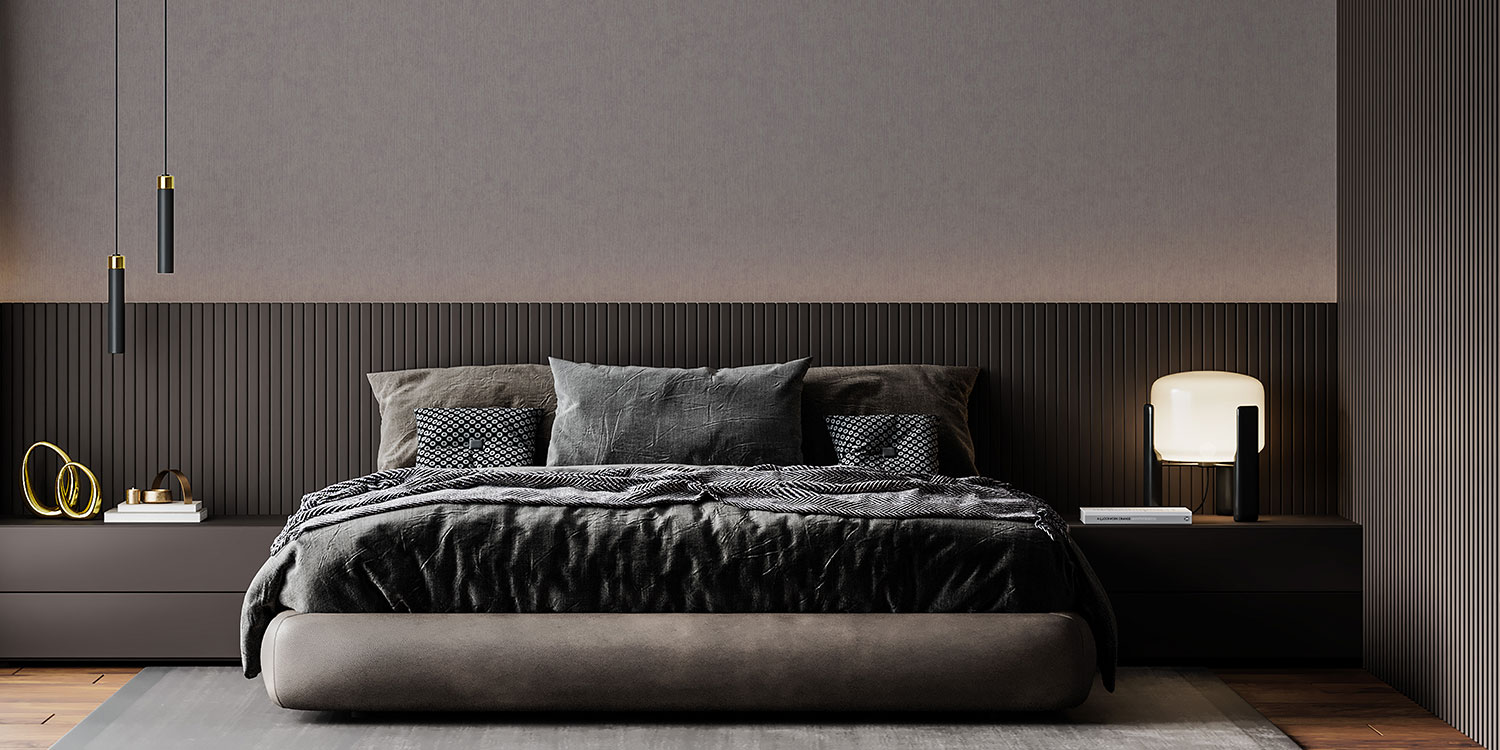
PVC Decorative Film for Furniture and Interior Surfaces
PVC Decorative Film for Furniture gives furniture panels and interior components a finished appearance without relying on natural wood, stone, leather, or textile as the surface material. Through printing, embossing, coating, lamination, profile wrapping, and thermoforming, the film can create anything from subtle matte colors to detailed wood grain and high-gloss stone effects.
MSD develops PVC printable film for furniture, along with PVC film designed for direct embossing and coating. These materials are suitable for compatible cabinets, wardrobes, interior doors, decorative wall panels, furniture parts, profiles, and retail fixtures.
The film needs to work as part of a complete surface construction. Its formulation, thickness, width, flexibility, and thermal behavior must suit the substrate, adhesive, component shape, production equipment, and finishing process. Heating, pressure, coating, and cooling also affect color, texture, adhesion, and surface flatness.
This guide covers the structure, decorative options, processing methods, technical characteristics, applications, specifications, and selection factors associated with PVC decorative film.
What Is PVC Decorative Film for Furniture?
PVC Decorative Film for Furniture is a flexible polyvinyl chloride material used to finish furniture panels and interior surfaces. According to the intended application, it may be printed, colored, embossed, coated, laminated onto flat boards, wrapped around profiles, or formed over shaped components.
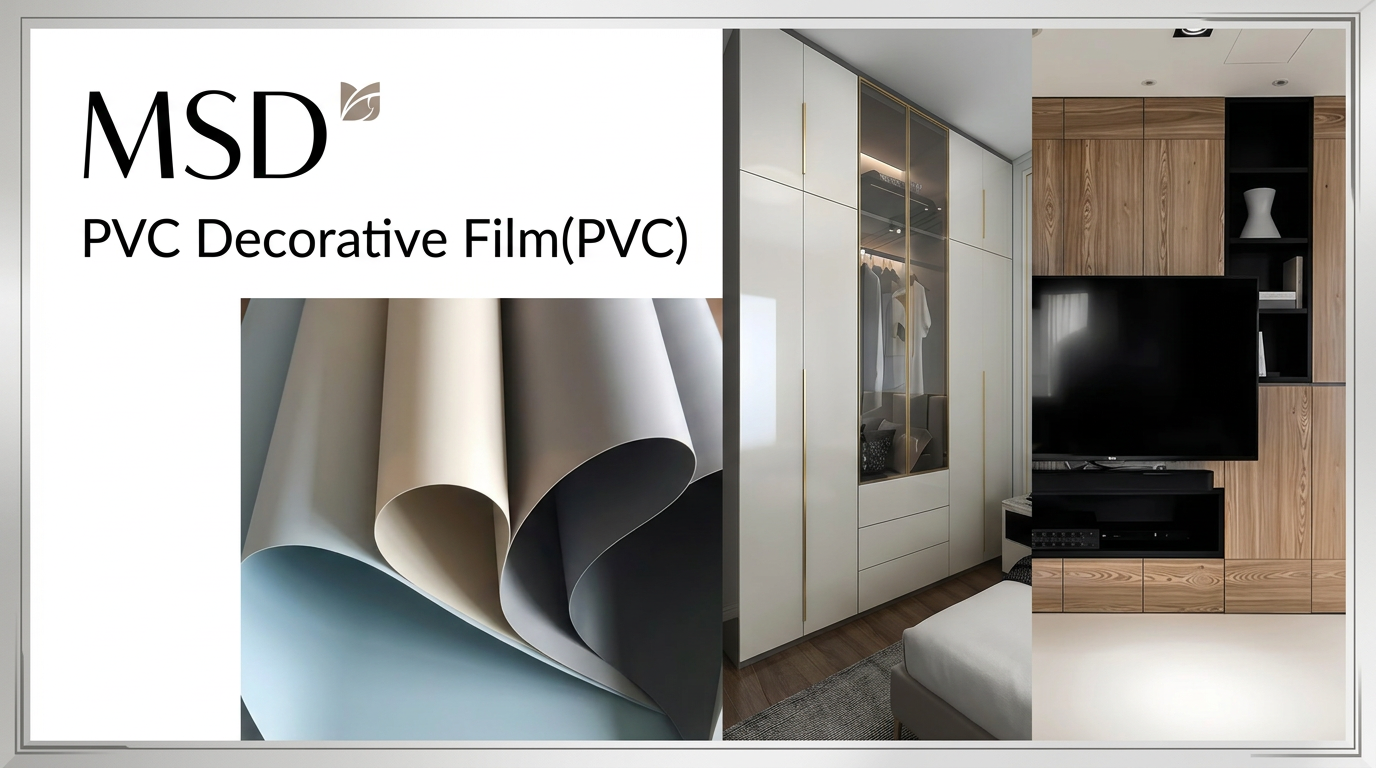
Available decorative directions include:
- Wood grain
- Marble and stone
- Concrete and mineral textures
- Textile-inspired patterns
- Leather-inspired grain
- Geometric graphics
- Abstract designs
- Solid colors
- Matte finishes
- Glossy finishes
- Tactile surfaces
A completed furniture surface may combine:
- PVC base film
- Printed or colored decoration
- Embossed texture
- Application-specific surface coating
- Compatible adhesive
- Prepared furniture substrate
PVC decorative film is a finishing layer rather than a load-bearing panel. It relies on the substrate for structural support and on the adhesive and processing method for secure application.
The appearance of the completed component depends on how well these materials work together. Dust, machining marks, loose particles, excessive substrate moisture, unsuitable adhesive, or inconsistent heating can remain visible or lead to bonding problems after application.
Main Types of PVC Decorative Film
MSD’s range includes printable PVC furniture film and PVC film developed for direct embossing and coating. Although both are used for decorative surfaces, they enter the production process at different stages.
PVC Printable Film for Furniture
PVC printable film provides a controlled surface for applying decorative graphics. After printing, it may pass through embossing, coating, lamination, wrapping, forming, or other compatible finishing stages.
Important characteristics include:
- Controlled base-film color
- Consistent surface quality
- Suitable ink interaction
- Clear print definition
- Stable color appearance
- Controlled dimensional behavior
- Predictable heat response
- Coating compatibility
- Lamination compatibility
- Stable roll flatness
Printable film can reproduce:
- Natural wood visuals
- Painted wood effects
- Marble and stone patterns
- Concrete surfaces
- Fabric-inspired designs
- Geometric graphics
- Abstract artwork
- Solid-color finishes
Printing is only one stage in the creation of the final surface. Embossing can change the way light falls across the pattern, while coating may deepen color or alter gloss. Lamination and thermoforming can also affect dimensions and visual tone. For that reason, the final assessment should be made after the planned processing stages have been completed.
PVC Film for Direct Embossing and Coating
PVC film for direct embossing and coating is intended for production routes in which mechanical embossing creates texture and a compatible coating modifies the upper surface.
Key points for evaluation include:
- Response to embossing
- Texture definition
- Stability under heat
- Coating adhesion
- Film flexibility
- Gloss control
- Surface feel
- Dimensional stability
- Lamination behavior
- Cleaning response
Direct embossing and coating do not refer to one specific appearance. Results vary with the embossing cylinder, pattern depth, film formulation, temperature, pressure, line speed, coating chemistry, curing method, and cooling conditions.
A shallow fine-grain emboss can create a soft matte appearance, while a deeper wood pore or textile structure produces a more pronounced tactile effect.
Structure of PVC Decorative Film
PVC decorative film may contain several functional elements. Each one contributes differently to appearance, processing, and the behavior of the completed furniture surface.
PVC Base Film
The PVC base film provides the main flexible structure. Its formulation can influence:
- Flexibility
- Tensile behavior
- Thermal response
- Forming performance
- Dimensional stability
- Embossing behavior
- Surface consistency
- Adhesive compatibility
- Interaction with coatings
A film used for flat panel lamination does not face the same forming demands as one stretched over a routed cabinet door. Deep recesses, curved edges, and narrow profiles require careful control of elongation, heat response, and surface stability.
Printed Decorative Layer
The printed layer creates the visible pattern and color. Its final appearance can be influenced by:
- Base-film shade
- Ink technology
- Printing resolution
- Pattern scale
- Color density
- Print repeat
- Drying or curing conditions
- Surface coating
- Interior lighting
Artwork should be developed with the finished component in mind. Broad wood grain or large stone veins may suit full-size doors and wall panels, but the same artwork can appear crowded or fragmented on a narrow moulding.
Print direction also matters. Grain orientation should align logically across doors, drawer fronts, side panels, and wrapped profiles when the design calls for visual continuity.
Embossed Texture
Embossing forms a tactile pattern by applying controlled heat and pressure to the film surface.
Possible textures include:
- Wood pores
- Brushed timber
- Woven textile structures
- Leather-inspired grains
- Stone surfaces
- Geometric patterns
- Fine matte textures
Embossing may be coordinated with the printed artwork. In a wood design, for example, pore lines can follow the direction of the printed grain. This relationship can make the surface look more coherent and add visual depth.
Texture quality depends on pattern depth, heat distribution, pressure, film thickness, production speed, and cooling. Poor control can lead to uneven definition or unwanted gloss variation.
Surface Coating
An application-specific coating modifies the uppermost surface of the film.
Depending on its formulation, the coating may affect:
- Gloss
- Surface touch
- Stain response
- Cleaning behavior
- Visibility of scratches
- Interaction with chemicals
- Color depth
- Light reflection
Coating performance must be associated with a defined film construction and test method. A coating evaluated on a flat laminated panel may behave differently after the film is heated and stretched around a shaped component.
Decorative Designs and Surface Effects
PVC decorative film allows furniture, wall panels, doors, and interior components to share a coordinated visual language. The final effect comes from the interaction between pattern, color, embossing, gloss, coating, panel size, and lighting.
Wood-Grain PVC Film
Wood-grain PVC film can reproduce decorative themes inspired by oak, walnut, ash, pine, maple, and other timber species.
Design details may include:
- Grain direction
- Pattern repeat
- Knot placement
- Natural color variation
- Pore texture
- Panel scale
- Edge transitions
- Gloss level
- Direction of light
Pattern repeat should be considered across a group of finished components. Highly recognizable knots or grain features may become too obvious when repeated frequently across adjacent doors.
The relationship between print and embossing also affects realism. A pore texture aligned with the printed grain generally creates a more unified appearance than a texture running in an unrelated direction.
Stone and Marble Film
Stone-inspired film can create the visual character of:
- Marble
- Slate
- Concrete
- Terrazzo
- Limestone
- Mineral surfaces
Artwork scale should suit the component. Broad marble veins can work well on large wall panels or cabinet fronts, while compact patterns are often better suited to drawer faces, narrow panels, and smaller furniture parts.
The position of major veins should be planned around panel edges, hardware openings, joints, and adjacent components. This helps avoid abrupt visual breaks in important areas.
Textile and Leather-Inspired Film
Printing and embossing can create decorative surfaces inspired by linen, canvas, woven fabric, and leather grain.
These effects add warmth and tactile detail to wardrobes, wall panels, cabinet fronts, hospitality furniture, and decorative inserts.
They are PVC interpretations of other materials. Descriptions should therefore reflect their decorative character rather than presenting them as natural textile or genuine leather.
Solid-Color Film
Solid-color PVC film supports coordinated furniture ranges, cabinetry, doors, storage systems, and interior color schemes.
Color appearance can be influenced by:
- Substrate shade
- Adhesive layer
- Film thickness
- Surface gloss
- Interior lighting
- Viewing angle
- Adjacent finishes
The same color may look different on matte and glossy surfaces. Warm and cool lighting can also shift the perceived tone, so samples should be viewed under lighting similar to that planned for the finished space.
Matte, Glossy, and Tactile Finishes
Each finish creates a different visual impression and brings its own production and maintenance considerations.
Surface Finish Visual Character Evaluation Focus
| Matte |
Soft appearance with limited reflection |
Gloss consistency, cleaning marks, and texture uniformity |
| Satin |
Moderate reflection with balanced depth |
Light direction, color appearance, and maintenance |
| Glossy |
Stronger reflection and greater visual depth |
Panel flatness, surface marks, and substrate preparation |
| High-gloss |
Pronounced reflectivity for selected designs |
Lamination control, substrate quality, and surface inspection |
| Tactile coating |
Defined surface feel created by a compatible coating |
Adhesion, flexibility, touch, and cleaning response |
| Embossed finish |
Physical texture formed through heat and pressure |
Pattern depth, registration, processing temperature, and cooling |
Samples are best assessed on the intended substrate. A loose film sample may not fully reveal surface flatness, gloss, color depth, or the visibility of panel imperfections after lamination.
Processing Methods for PVC Decorative Film
PVC decorative film can be applied through several production methods. Each route creates its own requirements for heat response, flexibility, adhesion, dimensional control, and surface stability.
Vacuum Forming and 3D Lamination
Vacuum forming uses controlled heating and pressure difference to shape PVC film over a three-dimensional panel. It is commonly used for routed cabinet doors, furniture fronts, and components with recessed, raised, or curved details.
Important factors include:
- Film formulation
- Film thickness
- Heating consistency
- Forming temperature
- Vacuum level
- Panel geometry
- Groove depth
- Edge radius
- Adhesive activation
- Cooling time
- Trimming method
The film experiences greater stretching at corners, deep grooves, and sharply formed edges. These areas should be examined for thinning, color shift, gloss change, texture distortion, incomplete bonding, or lifting.
A representative forming trial helps establish suitable settings before regular production. The test component should include the most demanding shapes expected in the actual application.
Flat Lamination and 2D Lamination
Flat lamination bonds decorative film to a planar panel using adhesive, controlled pressure, and suitable processing conditions.
Important variables include:
- Panel flatness
- Adhesive distribution
- Roller pressure
- Film tension
- Line speed
- Processing temperature
- Surface cleanliness
- Cooling
- Edge trimming
This method is commonly used for furniture panels, shelves, wall panels, door components, and other flat interior surfaces.
High-gloss finishes demand particularly careful substrate preparation. Small particles, sanding marks, or panel irregularities may become more visible after the reflective film is laminated.
Profile Wrapping
Profile wrapping applies decorative film around long, shaped components such as frames, trims, mouldings, rails, and furniture profiles.
The process should consider:
- Profile geometry
- Corner radius
- Film flexibility
- Adhesive activation
- Line speed
- Wrapping tension
- Edge bonding
- Cooling
- Cutting accuracy
Tight corners, deep channels, and narrow grooves place different demands on the film than broad, flat profiles. Film thickness and flexibility should therefore be matched to the actual profile geometry.
Heated and Cold Lamination
Some surface systems use heated lamination, while others apply limited additional heat. The suitable route depends on the film, adhesive, substrate, production equipment, and desired finish.
A processing trial should examine:
- Adhesive activation
- Dimensional movement
- Surface appearance
- Bonding strength
- Color change
- Gloss change
- Edge stability
- Cooling behavior
Heat can improve forming or adhesive activation, but excessive exposure may alter film dimensions, printed color, surface gloss, or coating characteristics.
Printing, Embossing, and Coating Compatibility
Printing, embossing, and coating are connected stages rather than isolated operations. Conditions used at one stage can influence the film’s behavior during the next.
Printing Evaluation
A representative printing trial can examine:
- Film feeding
- Ink adhesion
- Image definition
- Color reproduction
- Pattern registration
- Drying or curing
- Dimensional movement
- Surface contamination
- Appearance after coating
- Appearance after lamination
Final color and texture should be assessed only after all planned production stages have been completed.
Embossing Evaluation
Embossing behavior depends on:
- Film formulation
- Film thickness
- Heating temperature
- Roller pressure
- Pattern depth
- Processing speed
- Print registration
- Cooling conditions
Excessive temperature or pressure can change dimensions, gloss, color, or surface definition. Insufficient heat or pressure may leave the pattern shallow, uneven, or unstable.
Coating Evaluation
Coating compatibility should be reviewed in relation to:
- Surface energy
- Coating adhesion
- Curing method
- Curing temperature
- Film flexibility
- Gloss level
- Surface touch
- Cleaning response
- Chemical interaction
- Forming behavior after coating
A coating that performs well on a flat surface may crack, whiten, lose adhesion, or change gloss when the film is stretched over deep recesses. Testing should reproduce the intended forming conditions.
Technical Characteristics of PVC Decorative Film
Technical properties influence how the film moves through printing and finishing equipment, how it bonds to the substrate, and how the completed surface responds to routine interior use.
Flexibility and Formability
Flexibility allows suitable PVC film to follow flat, curved, recessed, and profiled components.
Required flexibility varies with:
- Component geometry
- Groove depth
- Edge radius
- Film thickness
- Heating conditions
- Forming pressure
- Cooling method
A film needs enough flexibility to cover the component without cracking or losing adhesion, while still maintaining dimensional control and a stable surface appearance.
Surface Uniformity
Consistent thickness and surface condition support reliable printing, embossing, coating, and lamination.
Inspection may identify:
- Thickness variation
- Gels or particles
- Bubbles
- Wrinkles
- Lines
- Color differences
- Gloss variation
- Edge damage
- Roll deformation
The significance of each item depends on the intended finish. A small surface defect may be more visible in a high-gloss solid color than in an embossed wood-grain pattern.
Dimensional Stability
Printing, heating, embossing, lamination, forming, and cooling can all cause dimensional movement.
Excessive change may lead to:
- Pattern misalignment
- Wrinkling
- Width variation
- Movement at panel edges
- Surface distortion
- Registration errors
Film behavior should be evaluated under production conditions that reflect the intended temperature, tension, pressure, and processing time.
Adhesion Compatibility
Bonding between the film and substrate may be influenced by:
- Adhesive chemistry
- Film surface
- Substrate porosity
- Surface preparation
- Adhesive quantity
- Temperature
- Pressure
- Processing time
- Cooling conditions
- Finished-use environment
Initial attachment does not necessarily represent long-term bonding behavior. Adhesion should be checked after the completed component has cooled and received suitable conditioning.
Scratch and Abrasion Response
Scratch and abrasion describe different forms of surface change:
- Scratch response concerns visible marks caused by concentrated contact with a hard or sharp object.
- Abrasion response concerns gradual surface wear caused by repeated rubbing.
Both may be influenced by the PVC formulation, upper coating, gloss level, texture, contact material, and test method. A favorable abrasion result does not automatically indicate the same response to scratching, impact, or cutting.
Stain and Cleaning Response
Applicable surface coatings can support routine furniture cleaning. The result depends on:
- Type of stain
- Contact duration
- Surface texture
- Coating construction
- Cleaning solution
- Cleaning tool
- Applied pressure
Testing should be carried out on the completed surface. Base film alone cannot represent how the printed, embossed, coated, and laminated structure will respond.
Color and Light Stability
Natural and artificial light can gradually influence color appearance. The degree of change may depend on:
- Pigment or ink technology
- Surface coating
- Light intensity
- Exposure duration
- Temperature
- Interior lighting
- Surface gloss
Any light-stability value should be associated with the relevant film construction and test procedure.
Heat Response
Heat is commonly used during embossing, lamination, profile wrapping, and vacuum forming. Excessive temperature may alter dimensions, gloss, texture, coating, or printed color. Insufficient temperature may prevent proper shaping or adhesive activation.
Suitable settings should be established through trials involving the intended film, substrate, adhesive, component shape, and production equipment.
PVC Decorative Film Specifications
The table below summarizes the principal specification areas associated with this category.
| Specification |
Displayed Range or Type |
Selection Consideration |
| Material |
PVC |
Match the film with the planned furniture-surface process |
| Product type |
Printable film or film for embossing and coating |
Define the required production stage |
| Thickness |
Selected products around 0.06–0.50 mm |
Consider forming, wrapping, lamination, and surface requirements |
| Width |
Selected products around 1.00–1.45 m |
Coordinate with equipment and component dimensions |
| Design |
Wood, stone, textile, geometric, or solid color |
Match the pattern scale with the panel and interior concept |
| Surface finish |
Matte, satin, glossy, high-gloss, embossed, or tactile |
Review appearance, maintenance, and processing behavior |
| Processing route |
Printing, embossing, coating, lamination, wrapping, or forming |
Verify suitability through an application trial |
| Substrate |
Prepared wood-based, plastic, composite, or compatible metal surface |
Assess flatness, porosity, heat tolerance, and bonding |
| Coating |
Application-specific surface treatment |
Check adhesion, curing, flexibility, and cleaning response |
These ranges represent selected film constructions in the MSD category. Available dimensions, colors, finishes, treatments, and processing characteristics should be verified for the relevant film grade.
Applications of PVC Decorative Film
PVC decorative film can be used across cabinetry, furniture, interior doors, wall systems, display fixtures, and wrapped profiles. The film construction and processing route should reflect the component geometry and expected use.
Kitchen Cabinets
PVC decorative film can be laminated to flat cabinet panels or formed over compatible shaped doors.
Kitchen applications should consider:
- Exposure to heat
- Grease and cooking residue
- Water contact
- Cleaning frequency
- Edge adhesion
- Hardware openings
- Substrate stability
The film does not replace appropriate panel sealing or moisture-control details. Cut edges, joints, sink areas, and hardware openings still require careful design and finishing.
Wardrobes and Storage Furniture
Decorative film can be applied to:
- Wardrobe doors
- Side panels
- Drawer fronts
- Shelving components
- Decorative trims
- Interior storage panels
Wood grain, matte solid colors, textile-inspired surfaces, and coordinated finishes can support consistent furniture collections across several component types.
Interior Door Panels
Door applications should take into account:
- Panel dimensions
- Edge finishing
- Frequent surface contact
- Hardware openings
- Light exposure
- Substrate movement
- Cleaning requirements
Large, uninterrupted door faces can reveal panel unevenness and lamination marks more clearly, particularly with glossy finishes or strong directional lighting.
Decorative Wall Panels
PVC decorative film can provide coordinated wall-panel surfaces in homes, hotels, offices, cultural venues, and retail interiors.
Planning should account for:
- Joints
- Corners
- Doors and service openings
- Panel alignment
- Pattern continuity
- Applicable fire requirements
- Access to building services
Where technical classifications are specified, the relevant information should cover the complete wall-panel construction rather than the decorative film alone.
Office Furniture
Applicable surfaces include:
- Cabinets
- Shelving
- Storage systems
- Meeting-room furniture
- Partitions
- Decorative panels
Horizontal surfaces exposed to frequent contact may need additional evaluation of the surface coating, bonding, substrate, and complete panel structure.
Hospitality Furniture
Wood, stone, textile, and solid-color films can be used on:
- Guest-room furniture
- Reception components
- Wardrobes
- Decorative panels
- Storage units
- Interior fixtures
Cleaning methods, contact levels, lighting conditions, and applicable technical documentation should be considered for the selected construction.
Retail Fixtures
PVC decorative film can support:
- Display cabinets
- Product backgrounds
- Wall fixtures
- Counters
- Shelving components
- Coordinated interior themes
Pattern placement should reflect signage, lighting, shelves, products, and the normal viewing distance.
Profile Wrapping
Compatible PVC film can be wrapped around:
- Frames
- Trims
- Mouldings
- Furniture profiles
- Decorative rails
- Linear interior components
Film flexibility, profile geometry, adhesive behavior, line speed, tension, and cooling all contribute to a stable wrapped surface.
How to Select PVC Decorative Film for Furniture
Film selection should begin with the manufacturing process, component shape, substrate, and expected use. Pattern and color are important, but they should follow technical compatibility.
1. Define the Surface Process
Identify the intended processing route:
- Vacuum forming
- 3D lamination
- Flat lamination
- Profile wrapping
- Heated film covering
- Cold lamination
- Direct embossing
- Surface coating
Each method creates different requirements for flexibility, heat response, adhesive interaction, and dimensional stability.
2. Identify the Substrate
Confirm the substrate’s:
- Material type
- Porosity
- Moisture condition
- Heat tolerance
- Surface flatness
- Structural stability
- Preparation requirements
Wood-based panels, composites, plastics, and compatible metal surfaces do not behave identically under heat and pressure.
3. Review Component Geometry
Flat panels, curved components, deep grooves, routed doors, narrow profiles, and sharp transitions create different forming demands.
The smallest corner radius and deepest recess often determine whether a film is suitable for the entire component.
4. Select Film Thickness
Thickness should be assessed alongside flexibility, surface coverage, thermal response, forming behavior, and equipment capability.
A thicker film is not automatically more suitable. Complex forms may require a carefully balanced combination of thickness, elongation, heat response, and dimensional stability.
5. Confirm Film Width
Film width should reflect:
- Equipment capacity
- Panel dimensions
- Wrapping allowance
- Edge trimming
- Pattern direction
- Material utilization
Practical working width may be narrower than the nominal roll width once trimming and process allowances are included.
6. Define the Decorative Effect
Specify the required:
- Pattern
- Color
- Gloss
- Texture
- Embossing
- Coating
- Surface feel
- Print repeat
The selected design should be reviewed at the actual component scale and under representative lighting.
7. Review Adhesive Compatibility
The adhesive should suit:
- PVC film surface
- Substrate type
- Processing temperature
- Pressure conditions
- Component shape
- Intended interior environment
Bonding should be evaluated after cooling and conditioning, including corners, grooves, edges, and other areas where stress is concentrated.
8. Conduct an Application Trial
A practical trial can assess:
- Printing
- Embossing
- Coating
- Forming
- Lamination
- Edge adhesion
- Color shift
- Gloss variation
- Cooling response
- Finished-surface appearance
The trial should use the intended substrate, adhesive, component geometry, and processing settings. A simple flat sample may not reveal issues that arise on curved edges or deep recesses.
Why Choose MSD PVC Decorative Film for Furniture?
MSD develops PVC Decorative Film for Furniture within its home decoration material portfolio. The range includes printable PVC film and PVC film designed for direct embossing and coating, supporting compatible furniture, cabinetry, door, wall-panel, and profile-wrapping applications.
MSD brings together PVC formulation, film production, surface management, print compatibility, embossing assessment, coating interaction, and application development within an integrated manufacturing framework.
Relevant MSD capabilities include:
- PVC base-film development
- Printable furniture-film production
- Film development for direct embossing
- Coating-compatible surface development
- Thickness and width control
- Base-color evaluation
- Surface-uniformity management
- Matte and glossy surface development
- Support for wood, stone, textile, and solid-color designs
- Embossing-response evaluation
- Print-interaction testing
- Lamination and forming assessment
- Roll and edge inspection
- Application-focused specification development
- Technical documentation for applicable products
MSD also examines how the film interacts with substrates, adhesives, ink systems, embossing equipment, coatings, temperature, pressure, and cooling methods.
Where a project defines a particular color, thickness, surface characteristic, forming response, or test value, the technical information should correspond with the selected film construction and evaluation method.
Frequently Asked Questions About PVC Decorative Film
The following answers cover common questions about PVC furniture film, printing, embossing, lamination, forming, substrate preparation, and available dimensions.
What types of PVC decorative film does MSD provide?
MSD’s category includes PVC printable film for furniture and PVC film developed for direct embossing and coating. Selection depends on the intended production stage, surface design, component geometry, and finishing method.
What is printable PVC furniture film?
Printable PVC furniture film is a base film with a surface developed to receive decorative printing. It can carry wood, stone, concrete, textile-inspired, geometric, abstract, or solid-color designs before further finishing, coating, or lamination.
What does direct embossing mean?
Direct embossing uses controlled heat and pressure to form a physical texture on the film surface. Pattern quality depends on the film formulation, embossing roll, temperature, pressure, processing speed, and cooling conditions.
Can PVC decorative film be used on MDF?
Applicable PVC film can be laminated or formed over properly prepared MDF. The board should be clean, dry, smooth, stable, and compatible with the chosen adhesive and processing conditions.
Machining dust, loose fibers, uneven sanding, or excessive moisture can affect surface appearance and adhesion.
Can PVC decorative film be used on cabinet doors?
Yes. Compatible PVC film can be applied to flat or shaped cabinet doors through lamination or vacuum-forming processes.
Film selection should account for door geometry, groove depth, edge radius, adhesive activation, heating conditions, and cooling.
What is the difference between flat lamination and vacuum forming?
Flat lamination applies decorative film to a planar substrate using adhesive and pressure. Vacuum forming heats the film and shapes it over a three-dimensional component containing recessed, raised, curved, or routed details.
Can PVC film be wrapped around profiles?
Applicable flexible film can be used for profile wrapping. Suitability depends on profile geometry, corner radius, film thickness, flexibility, adhesive, line speed, wrapping tension, and cooling.
Does film thickness determine quality?
No. Thickness affects handling, forming, and surface coverage, but it is only one factor.
Film formulation, thickness uniformity, print response, heat behavior, coating compatibility, adhesive interaction, substrate quality, and application method also influence the completed surface.
What thickness is available?
Selected products within this category are presented in an approximate thickness range of 0.06–0.50 mm. Available thickness depends on the film construction and intended processing route.
What widths are available?
Selected products are presented in widths of approximately 1.00–1.45 metres. Current width options should be confirmed for the relevant film grade.
Can PVC decorative film be cleaned?
Applicable finished surfaces can support routine cleaning with compatible, non-abrasive methods. Cleaning behavior depends on the upper coating, embossing depth, gloss, stain type, cleaning solution, and tool used.
A new cleaning method should first be tested on a discreet area of the finished component.
PVC Decorative Film for Furniture brings together flexible material technology and decorative surface design. Printable film supplies the visual pattern, embossing adds physical depth, and an application-specific coating can adjust gloss, touch, cleaning response, and overall appearance.
The film’s success depends on more than its color, pattern, or nominal thickness. Substrate quality, adhesive selection, printing technology, embossing conditions, coating chemistry, temperature, pressure, component geometry, and cooling all influence the completed surface.
Evaluating these elements as one connected system provides a more reliable basis for selecting materials, setting processing parameters, and defining test methods for cabinets, wardrobes, doors, wall panels, furniture components, retail fixtures, and wrapped profiles.
MSD — PVC Printable Film and Embossing-Compatible Decorative Film for Furniture and Interior Surfaces.

 English