-
 Oct 16, 2026
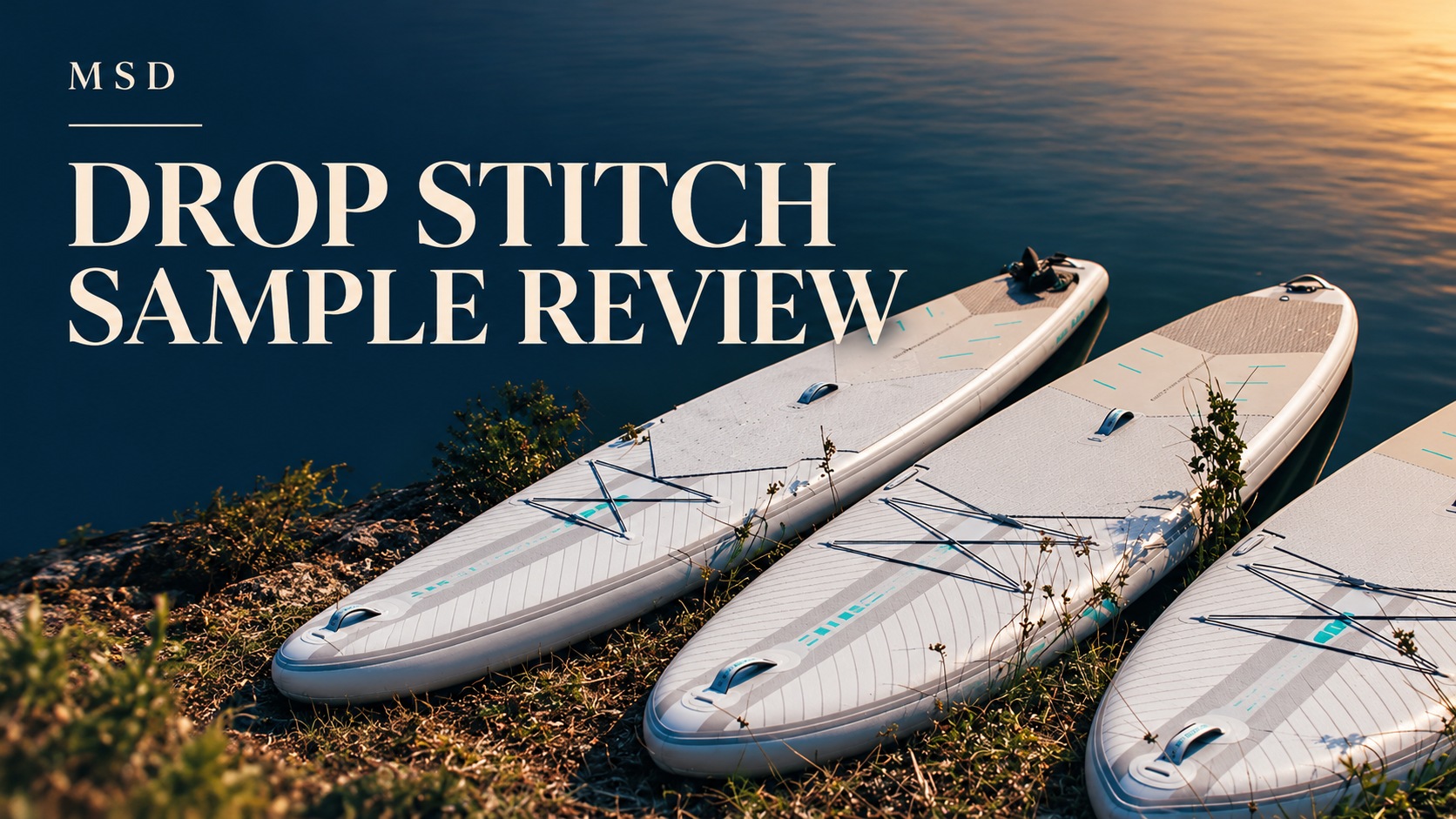
An inflatable-product OEM needs more than a material swatch to make a purchasing decision. A small sample can support an initial surface review, but it cannot represent every seam, valve interface or dimensional feature of a complete chamber. A better sample program connects the material discussion to a representative prototype and a written review plan.
MSD offers drop stitch and airtight inflatable materials. Its range distinguishes material systems and applications rather than giving one universal finished-product rating. For buyers, the practical task is to define the proposed construction and establish which evidence is needed before ordering production quantities.
Describe the intended chamber, not just the product name
A request for paddleboard material or mattress material leaves important design questions open. Provide an outline drawing showing the intended length, width, thickness, chamber arrangement and attachment positions. Identify the intended use environment and the design requirements established by your engineering team. Separate confirmed requirements from questions that still need development.
Ask the material supplier which parts of the proposed construction it can address. The main panel, perimeter material, reinforcement and attachment patches may need separate selections. Do not assume that one material code automatically covers every component. Make a bill of materials for the prototype, even if some entries remain provisional during the first discussion.
Divide the sample program into three decisions
Use an initial swatch to assess identity, handling and surface appearance. Next, request enough material for joining and interface trials using the intended fabrication route. Finally, build a representative chamber or product prototype for evaluation under an agreed plan. Each stage should answer a different question and have a clear decision about whether to continue.
Sample stage
Main decision
What it should not imply
Material swatch
Whether the proposed material merits further evaluation
Approval of a finished inflatable product
Joint and interface coupons
Whether the selected joining route warrants prototype work
Acceptance of every seam geometry
Representative prototype
Whether the complete construction meets the agreed review plan
Automatic approval of later design changes
Agree the amount and form of trial material before shipment. A sample too small for the intended seam layout may force the fabricator to improvise. Explain the planned coupons and prototype dimensions so that the supplier can discuss a practical sample supply, including identification and any handling instructions.
Keep joining trials tied to actual equipment
Ask the fabrication team to evaluate the proposed material using the process intended for production. Record the equipment, material orientation, joint geometry and relevant settings. Any adhesive system or welding route should be selected with appropriate technical guidance. Avoid transferring a successful result from another polymer system or surface treatment without a new compatibility review.
Include a straight joint and any representative corners or transitions in the trial plan. Mark the specimens and retain them after evaluation. If the team adjusts the process, record the revision instead of mixing results from several conditions into one summary. This helps distinguish a material question from a fabrication-setting question when the result needs investigation.
Review valves and attachments as interfaces
A prototype review should identify how valves, handles and other attachments are connected to the chamber. Give each interface a drawing reference and specify the proposed patch or reinforcement. Ask the engineering team to define a suitable evaluation approach for those locations. An acceptable main-panel sample does not answer whether a particular attachment arrangement is suitable.
Where artwork or printing is planned near a seam or attachment, show it on the prototype drawing. Ask the fabricator whether printing changes the joining preparation or inspection process. Keep graphics and interface decisions in the same revision set. Otherwise, a later artwork change can reach production without the technical team reviewing its position.
Write the prototype review plan before the review
Specify the conditioning, observations, measurements and acceptance criteria required for the intended product. Have the responsible engineering team establish appropriate operating and test conditions, including any applicable requirements. Record the actual conditions used. Material literature should not be converted into a finished-product operating instruction without validating the complete construction.
Identify every material and component used in the prototype.
Record dimensions and the agreed measurement locations.
Document seam, valve and reinforcement construction.
Record the actual evaluation conditions and observations.
Assign each unresolved point an owner and a review action.
Retain prototype photographs and an approved revision history.
Keep unsuccessful observations in the report. A useful approval record explains what was evaluated and what changed before acceptance. If the prototype is revised, identify whether earlier results remain relevant or whether the affected evaluations need to be repeated. This makes the final purchasing decision easier to explain and reproduce.
Keep commercial comparisons on the same basis
When reviewing quotations, specify whether the price covers trial material, production rolls, selected component materials or a broader development package. Record usable dimensions and the quantity basis alongside the price. Ask each supplier to identify exclusions and unresolved requirements. A low material price does not tell the buyer how much approved prototype work remains. Compare the proposed route to a controlled production decision as well as the quoted supply. This also helps the purchasing team explain why a sample program needs a defined scope before it can be scheduled.
Set a review date after the engineering team has assessed the trial plan. Avoid promising a production release date while critical interface decisions remain open.
Carry the prototype identity into bulk procurement
Link the production order to the selected material codes, agreed specification, prototype revision and acceptance records. Ask how rolls and batches will be identified. Define the documentation to accompany delivery and how a proposed substitution will be reviewed. Include a first-production review when moving from a development sample to the intended manufacturing scale.
To begin a discussion, send the chamber drawing, intended use, fabrication route and sample plan to MSD through the contact page. Request current information for the proposed construction. The goal is a traceable path from material sample to reviewed prototype and controlled order, with each stage supporting the next purchasing decision.
-
 Oct 09, 2026
A loose decorative film sample helps a furniture buyer review color and texture. It does not answer every question about a finished cabinet door or wrapped profile. Before a bulk order, the more useful question is whether the proposed film works with the actual component, production route and agreed appearance requirements.
MSD's PVC decorative film range includes material for furniture and interior surfaces. The website describes several processing routes and surface options. Buyers should confirm the exact grade for their process rather than treating every item in the range as interchangeable. The following trial plan helps purchasing and production teams make that confirmation together.
Define the component before selecting the sample
Start with the part drawing and substrate specification. Identify whether the visible surface is flat, profiled or shaped around edges. State which faces and edges will be covered, and mark areas where surface appearance is especially noticeable. A broad flat sample may be suitable for an initial color review while leaving a critical shaped corner completely unexamined.
Give the supplier a concise description of the intended process and the equipment available. Include the adhesive or bonding system proposed by the fabricator, with its supplier instructions. Ask both parties to confirm compatibility and an appropriate trial approach. Film selection should follow that discussion; a buyer should not infer suitability solely from thickness or a photograph.
Build a trial set that represents production
Select several representative parts rather than choosing only the simplest panel. A useful set may include the largest visible face, a typical edge, a difficult corner and a component with a routed feature. Label each part and record the substrate batch. Keep trial preparation consistent so that a change in the board or adhesive does not become an unexplained variable.
Ask the fabricator to record its actual settings and handling sequence during the trial. The purchasing record need not become a machine manual, but it should identify which material and process combination produced the approved part. If the trial result is unacceptable, change one defined factor at a time where practical, then document what changed and why.
Trial item
Question for review
Evidence to retain
Flat face
Does color, gloss and texture match the intended finish?
Approved finished panel
Edge and corner
Is the local appearance acceptable after processing?
Marked part and close-up photographs
Bonded construction
Does it meet the agreed evaluation procedure?
Trial report with material identification
Assembly match
Do adjacent doors and profiles look consistent?
Viewed assembly under agreed lighting
Agree what an appearance match means
Ask the design and production teams to review finished components together. Define the lighting, viewing distance and orientation used for appearance approval. Directional grain and texture should be oriented consistently across the assembly unless the design specifies otherwise. Record this decision on the cutting or component plan so that it is available when production starts.
Where several components must match, approve them side by side. A separate approval for each sample can overlook differences that become visible only in an assembled row of doors. Retain a physical master and identify it clearly. Photographs support communication, but the agreed physical reference should remain available for later batch comparisons.
Give bond and surface checks a defined procedure
Ask the technical team to specify the evaluation methods and acceptance criteria appropriate to the intended furniture use. Define the conditioning period before assessment and the locations to be examined. Include the relevant edges and shaped areas. Use the adhesive and film suppliers' guidance when planning the work, and have the responsible team interpret the results.
Cleaning and handling requirements also deserve a written review. If the finished furniture will be cleaned with a particular product, identify it and request an appropriate compatibility evaluation. Avoid replacing this discussion with broad terms such as easy-clean or durable. The procurement decision is stronger when the actual use condition and the agreed assessment are both recorded.
Identify the exact film, substrate and bonding materials.
Record the trial part geometry and production route.
Agree the timing and method for appearance and bond review.
Retain accepted parts with signatures or approval references.
Record any conditions that require a new trial.
Turn the approved part into an order specification
The purchase order should connect the selected film to its code, finish, quantity, roll dimensions and approved reference. State how production batches will be identified and whether matching components need material from a coordinated supply. Ask for written confirmation of usable width and packing details before calculating the final cutting plan and order quantity.
Include a change-control point. If the supplier proposes a different grade, surface treatment or construction, ask whether the earlier trial still applies. Likewise, a change to substrate or adhesive at the furniture factory may justify another review. Treat the approved sample as evidence for a defined combination, rather than as a permanent approval for every future variation.
Resolve responsibility for matching adjacent parts
A furniture order may combine laminated faces with wrapped profiles or components finished elsewhere. Put these parts in one approval group and name the person responsible for the final assembly match. Ask each fabricator to identify the material it will use before approving the group. If one component changes, review the assembled appearance again rather than checking that component in isolation. This makes the approval record useful for purchasing complete furniture sets, where the customer sees several surfaces together and may reasonably expect the agreed design to remain consistent across them.
Check the first production parts before scaling up
When bulk film arrives, compare its identification with the order and retained reference. Ask production to review the first representative components before releasing a long run. Keep the review focused on the features agreed during the trial: appearance, edges, assembly match and the defined technical checks. Record any deviation before more material is consumed.
For a material inquiry, send MSD the component drawings, intended lamination or wrapping route, finish reference and anticipated quantity through its contact page. Ask for a suitable sample recommendation and current product information. A coordinated sample review gives the buyer a practical basis for ordering, receiving and approving the material used in real furniture production.
-
 Oct 02, 2026
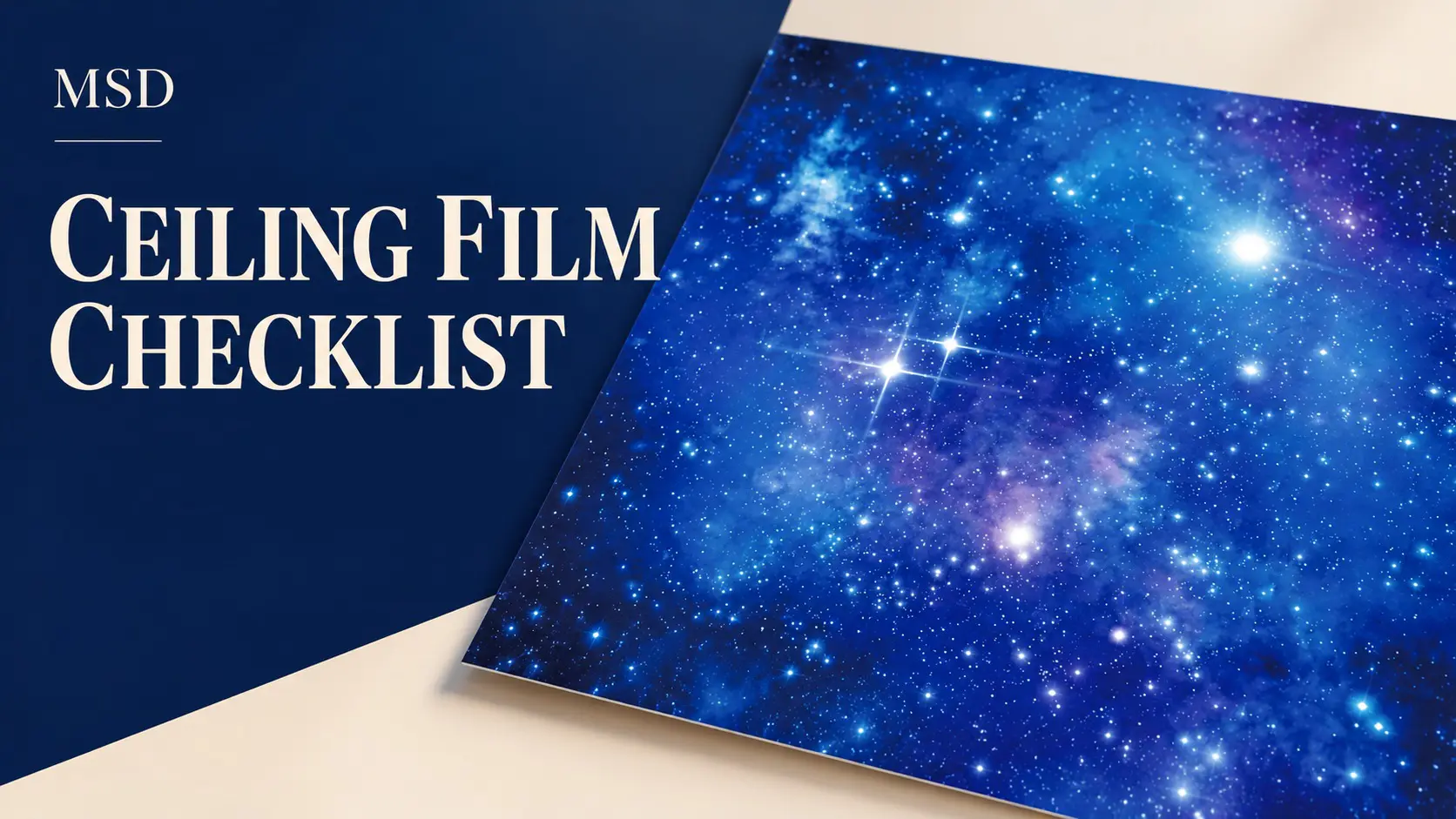
A printed ceiling can look convincing in an artwork file yet raise practical questions when an installer prepares the membrane. Which direction should the image face? Where will a light fitting interrupt the design? Does the approved sample represent the film that will arrive in bulk? For commercial fit-out buyers, these questions belong in the purchase brief before the order is released.
MSD lists printed and artistic options within its PVC artistic ceiling film range. Use that range as a starting point for discussion, then confirm the selected item and its current technical documentation. The checklist below is a purchasing workflow; final installation settings and suitability need agreement with the supplier and the ceiling-system installer.
Begin with a room drawing and an artwork map
Send a dimensioned ceiling plan rather than only the total floor area. Mark perimeter changes, columns, access openings, fittings and visible sightlines. Identify the main viewing direction from the entrance. For a directional picture, label its top edge on the drawing and on the approved artwork. This makes the intended orientation clear to both the printing team and the installer.
Ask who will prepare the production layout and how allowances will be handled. A finished ceiling dimension and a film cutting dimension serve different purposes. The installer should define the required system allowances; a buyer should avoid adding an arbitrary percentage. Keep the drawing revision beside the artwork revision so that an updated room plan cannot accidentally be paired with an obsolete graphic.
Separate roll specifications from visible artwork dimensions
A nominal roll width does not by itself confirm the uninterrupted printable or usable area. Request the usable width for the chosen construction, the proposed image dimensions and the intended position of any joins. If several panels form one image, ask for a layout showing how the graphic continues across them. This is especially useful for straight architectural lines and repeated geometric patterns.
Order item
What to confirm
Approval record
Material identity
Selected film code, surface and declared dimensions
Current specification with revision
Image layout
Orientation, scale, crop and panel sequence
Numbered artwork proof
Usable area
Print margins, trim and installation allowances
Supplier and installer layout agreement
Delivery format
Roll direction, labels and packing arrangement
Packing instructions linked to room numbers
Specify whether quantity is purchased by area, roll or project set, and show how waste and spare material are counted. A quotation comparison becomes more useful when each supplier prices the same deliverable. Otherwise, a lower unit price may simply exclude preparation or spare panels that another quotation includes.
Approve color in the intended lighting context
Review a physical print on the proposed material. A monitor proof is useful for checking wording and composition, but it should not be the sole acceptance reference for color and surface appearance. Ask for the sample to carry the film identification, print date and artwork revision. Retain a duplicate so that the purchasing team and the supplier can refer to the same approved appearance.
For a backlit design, discuss the actual lighting arrangement with the project team. Review an appropriate sample under representative lighting and assess image readability, bright areas, dark areas and the visibility of installation features. For an opaque decorative ceiling, assess appearance under the room's planned lighting. Do not assume that approval in one lighting arrangement covers another.
Use an installation sample to resolve interfaces
Where project complexity warrants it, ask the installer to demonstrate a representative corner, edge and fitting detail using the selected film and compatible system components. This review should answer practical interface questions before the full material shipment is committed. It is particularly helpful when an artwork feature sits close to a fitting or when several trades share the ceiling zone.
Confirm who approves perimeter and penetration details.
Check the graphic position against the latest services drawing.
Record the accepted appearance around a representative fitting.
Agree how damaged or incorrectly identified panels will be handled.
Keep installation instructions with the project handover documents.
Ask the responsible project professional to identify the applicable performance evidence for the location and use. Request documents for the exact proposed material and assembly where relevant. A general product description should not be treated as project approval, and an attractive sample should not substitute for the required documentation.
Make delivery labels useful on site
A project may involve similar-looking films for several rooms. Request labels that connect each roll or panel to the purchase order, material code, artwork revision and installation location. Include an unpacking sequence if the installer needs it. Agree how the supplier will communicate a material substitution or artwork change; neither should move forward on an informal assumption.
At receipt, compare labels with the packing list before distributing material around the building. Note transport damage and packaging condition, and follow the supplier's written storage instructions. Keep the identification information with any retained spare material. A spare without its artwork revision or room reference can create uncertainty when a repair is needed later.
Decide how a replacement panel will be specified
Before closing the order, discuss what information would be needed to reproduce a damaged panel. Keep the final production artwork, its scale and the accepted material reference in the project file. Ask whether a future replacement would require a new color review rather than assuming an exact visual match across separate production dates. Agree whether the project should retain a spare panel or spare material, and identify who will store it. This is a practical handover decision that is easier to make while the original order details are still available.
Send one coordinated inquiry
A useful inquiry combines the room plan, artwork map, selected finish, quantity basis, lighting context, delivery requirements and sample approval procedure. Send the same package to the supplier and installer, and nominate one person to resolve revisions. This creates a clearer route from design intent to an order that can be checked on arrival.
To discuss a printed ceiling film project with MSD, use the contact page and include the drawings and application details available. Request confirmation of the appropriate film and sample route before finalizing procurement. The aim is a documented material decision, with appearance, interfaces and supply details agreed together.
-
 Mar 29, 2026
From March 29th to 31st, 2026, the 29th China (Shanghai) International Boat and Technology Equipment Exhibition was successfully held at the Shanghai World Expo Exhibition and Convention Center. MSD (Booth No. H1G30) presented its DWF Spatial Fabric Expert Series, engaging in in-depth exchanges with global industry partners in the fields of yachts, sailboats, inflatable pads, and other water sports equipment.
At the exhibition, MSD highlighted its innovative fabric solutions for marine and water equipment, including yacht interior soft films, sailboat cover materials, and specialized coated fabrics for inflatable pads. These materials, based on the DWF technology platform and integrated with TPU Brush Fabric lightweight technology, achieve a balance between lightweight design and durability by precisely controlling the weight per unit area within 800-1100g/㎡, while maintaining strength, airtightness, and support through material thinning, structural optimization, and process innovation.
The DWF fabric offers reliable protection and durability, effectively withstanding harsh marine environments such as seawater corrosion and UV radiation, thereby extending the service life of equipment. Its lightweight design advantages include:
Portability: Compact volume and lightweight when deflated, facilitating easy carrying and storage;Energy efficiency: Reduced energy consumption for inflation and transportation, enhancing operational efficiency;Comfort: Soft texture, easy folding without creases, improving user experience;Environmental friendliness: Made from TPU material, 100% recyclable, offering a more eco-friendly alternative to traditional PVC materials.
This technology has achieved breakthroughs in multiple application areas:
Water sports: Lightweight paddleboards and kayaks (reducing weight by 30-50%);Outdoor camping: Ultra-light inflatable mattresses (below 800g/㎡);Sports equipment: Gymnastics mats, protective pads, portable yoga mats;Medical/military: Inflatable stretchers, rescue air cushions, portable tents.
During the exhibition, the MSD team conducted in-depth discussions with buyers from Europe, North America, and Southeast Asia, focusing on customized requirements for boat fabrics, such as enhanced salt spray corrosion resistance and optimized rapid deflation structure design. International clients showed significant interest in the application of DWF fabric for inflatable pads, recognizing its combination of lightweight and durability as an effective solution to industry challenges such as material aging and excessive weight in traditional materials.
MSD stated that it will continue to focus on the water sports equipment sector, enhancing material adaptability through technological innovation to advance the industry toward high-strength ultra-thin designs (weight <1100g/㎡), multifunctional integration (combining moisture permeability, antibacterial properties, flame resistance, and UV protection), and green manufacturing (utilizing fully bio-based TPU and 100% recycling technology), supporting the marine industry's journey toward lighter, greener, and more durable sustainable development.
-
 Mar 12, 2026
From March 12 to 14, 2026, the China Home Furnishings Fair (CHF) took place at the China International Exhibition Center (Shunyi Hall). MSD (Booth No. E2-C20) successfully completed its three-day participation, engaging in exchanges with professional visitors and purchasers from both domestic and international markets.
During the event, the company focused on showcasing core products suitable for interior decoration and soft furnishings, including Cloud Silk Art Soft Film, Printable Art Wall Covering (1.26 - 3.2meters), Self-Adhesive Wall Covering, and Wide-Format PET Film. Combining eco-friendly, durability, and aesthetic appeal, these materials met the functional and visual demands of home soft furnishings and commercial spaces, sparking in-depth discussions among visitors regarding their application scenarios and craftsmanship.
This participation focused on expanding into international markets. Through product displays and technical exchanges, MSD directly presented its production strength and R&D capabilities to overseas partners. The team established initial contacts with purchasers from Europe, Southeast Asia, and other regions, communicating in detail about material specifications, environmental standards, and customization needs, thereby accumulating key information for future product development and market layout.
We thank all partners who visited our booth. For clients unable to communicate on-site, the company keeps its cooperation channels open. You may obtain product technical manuals, application cases, and sample support via online channels. The MSD team is ready to provide one-on-one consulting to assist global customers in exploring innovative soft furnishing material solutions.
-
 Mar 04, 2026
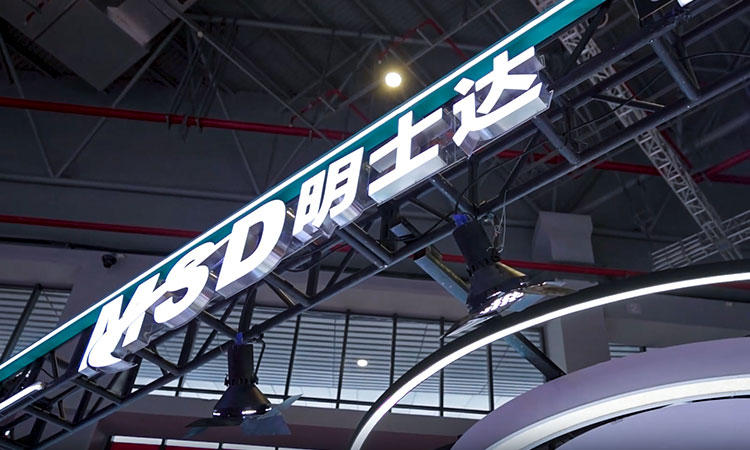
From March 4 to 7, 2026, the Shanghai International Advertising, Signage & Printing Technology Exhibition (APPPEXPO) was held at the National Exhibition and Convention Center (Shanghai). MSD participated in the event, presenting a range of material products tailored for commercial scenarios, specifically addressing the needs of the advertising signage, printing, and packaging industries.
At the booth, the company highlighted its Cloud Art Film, Printable Wall Covering (width from 1.26 to 3.2meters), Self-Adhesive Wall Covering, and Wide-Format PET Backlit Film and PET Blockout film. Notably, the seamless art wall covering features a maximum width of 3.2 meters, which minimizes splicing work and enhances decoration efficiency for large spaces. The Translucent Film-97 is designed for light box advertising, balancing light uniformity with image clarity. Meanwhile, the printable self-adhesive wall covering simplifies construction processes through its self-adhesive design, catering to the rapid renovation needs of commercial spaces.
Printed samples on display covered diverse styles ranging from botanical patterns and portraits to cartoon images, demonstrating the material's excellent compatibility with high-precision inkjet printing.
During the exhibition, MSD engaged with professionals from advertising production and interior design, discussing practical applications of wide-format materials in shopping mall displays, hotel soft furnishings, and outdoor signage. Several purchasers expressed interest in the weather resistance of the double-sided PET film and the eco-friendly performance of the self-adhesive wall covering, noting that these products effectively balance creative design with construction efficiency.Through on-site interactions, the company gathered feedback regarding "color reproduction in large-format printing" and "adhesive stability of self-adhesive materials in humid environments," providing references for future product optimization. MSD stated it will continue to monitor technological iterations in the advertising printing industry and help customers improve project execution efficiency through material innovation.
-
 Mar 03, 2025
We firmly believe that true manufacturing value lies not only in superior product performance but also in our responsibility to the environment, our commitment to society, and our long-term vision for the future. Therefore, we drive green transformation through systematic thinking—spanning our own operations and the entire industrial chain. We deeply integrate decarbonization into our innovative DNA, leveraging intelligent technology to empower a sustainable future and provide next-generation material solutions for our clients.
How do we do it?
MSD is systematically advancing innovation to continuously improve energy and material efficiency. We are accelerating the electrification transition of machinery and systems, actively seizing growth opportunities brought by sustainable production, and empowering our customers with leading technologies to co-create a greener future.
-
 Mar 03, 2025
We firmly believe that true manufacturing value lies not only in superior product performance but also in our responsibility to the environment, our commitment to society, and our long-term vision for the future. Therefore, we drive green transformation through systematic thinking—spanning our own operations and the entire industrial chain. We deeply integrate decarbonization into our innovative DNA, leveraging intelligent technology to empower a sustainable future and provide next-generation material solutions for our clients.
How do we do it?
MSD is systematically advancing innovation to continuously improve energy and material efficiency. We are accelerating the electrification transition of machinery and systems, actively seizing growth opportunities brought by sustainable production, and empowering our customers with leading technologies to co-create a greener future.
-
 Mar 03, 2025
We firmly believe that true manufacturing value lies not only in superior product performance but also in our responsibility to the environment, our commitment to society, and our long-term vision for the future. Therefore, we drive green transformation through systematic thinking—spanning our own operations and the entire industrial chain. We deeply integrate decarbonization into our innovative DNA, leveraging intelligent technology to empower a sustainable future and provide next-generation material solutions for our clients.
How do we do it?
MSD is systematically advancing innovation to continuously improve energy and material efficiency. We are accelerating the electrification transition of machinery and systems, actively seizing growth opportunities brought by sustainable production, and empowering our customers with leading technologies to co-create a greener future.
-
 Mar 03, 2025
We firmly believe that true manufacturing value lies not only in superior product performance but also in our responsibility to the environment, our commitment to society, and our long-term vision for the future. Therefore, we drive green transformation through systematic thinking—spanning our own operations and the entire industrial chain. We deeply integrate decarbonization into our innovative DNA, leveraging intelligent technology to empower a sustainable future and provide next-generation material solutions for our clients.
How do we do it?
MSD is systematically advancing innovation to continuously improve energy and material efficiency. We are accelerating the electrification transition of machinery and systems, actively seizing growth opportunities brought by sustainable production, and empowering our customers with leading technologies to co-create a greener future.

 English