PVC/TPU Film for Flooring and Decorative Floor Structures
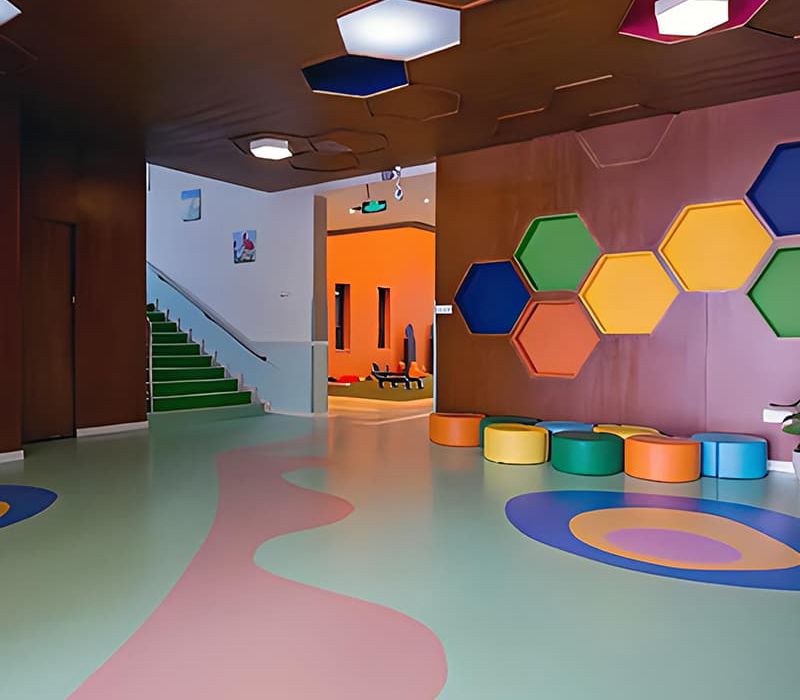
PVC/TPU Film for Flooring includes decorative and protective polymer films used in SPC, LVT, vinyl sheet, cushioned vinyl, and other compatible multilayer flooring products. According to its position in the structure, the film may display the printed pattern or form a transparent layer above it, helping shield the design from daily contact and gradual wear.
MSD develops PVC printable film, transparent PVC wear layers, and TPU wear layers for flooring applications. Printable film can reproduce wood, stone, concrete, textile, geometric, and customized visuals. Clear PVC or TPU film is placed over the decorative layer in suitable constructions, allowing the printed image to remain visible while adding a protective surface.
Flooring film cannot be assessed by material name or thickness alone. Width, transparency, print response, dimensional stability, thermal behavior, lamination settings, embossing conditions, and compatibility with neighboring layers all contribute to the finished result.
This guide examines how PVC and TPU flooring films work, where they are positioned, how they differ, and which technical and processing factors should be considered during material selection.
What Is PVC/TPU Film for Flooring?
PVC/TPU Film for Flooring is a group of polymer films used as decorative print layers or transparent wear layers in compatible floor constructions. PVC printable film carries the visible design. Transparent PVC or TPU wear film sits above the image and helps reduce direct exposure to foot traffic, cleaning, dust, and routine surface contact.
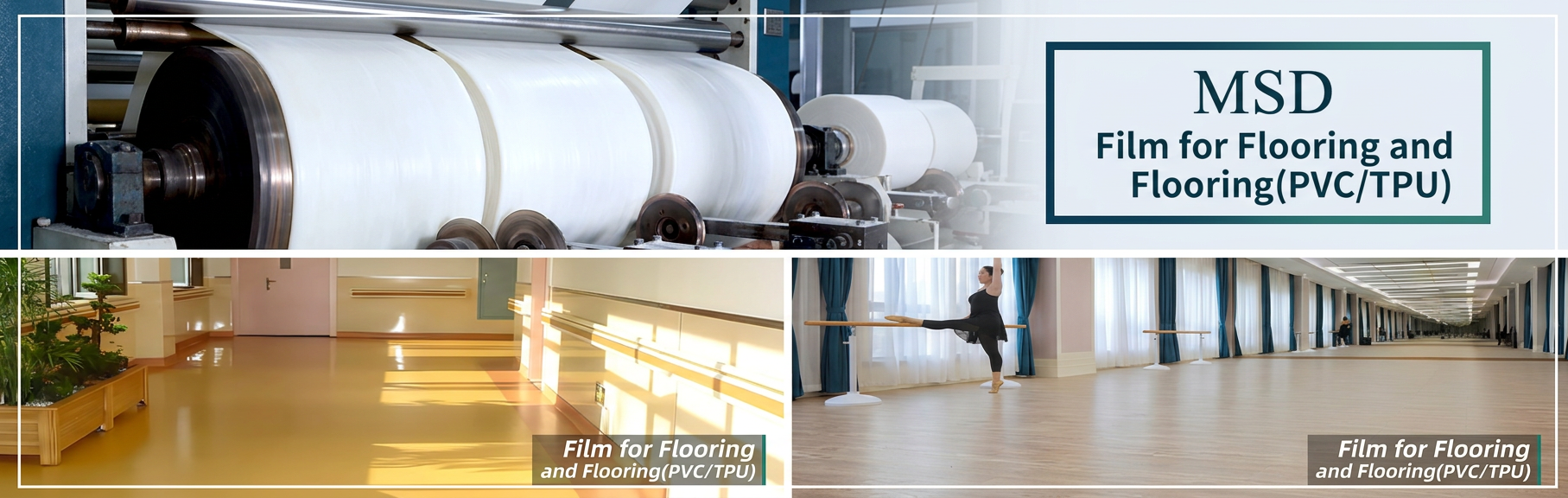
These films may be used in:
- SPC flooring
- LVT flooring
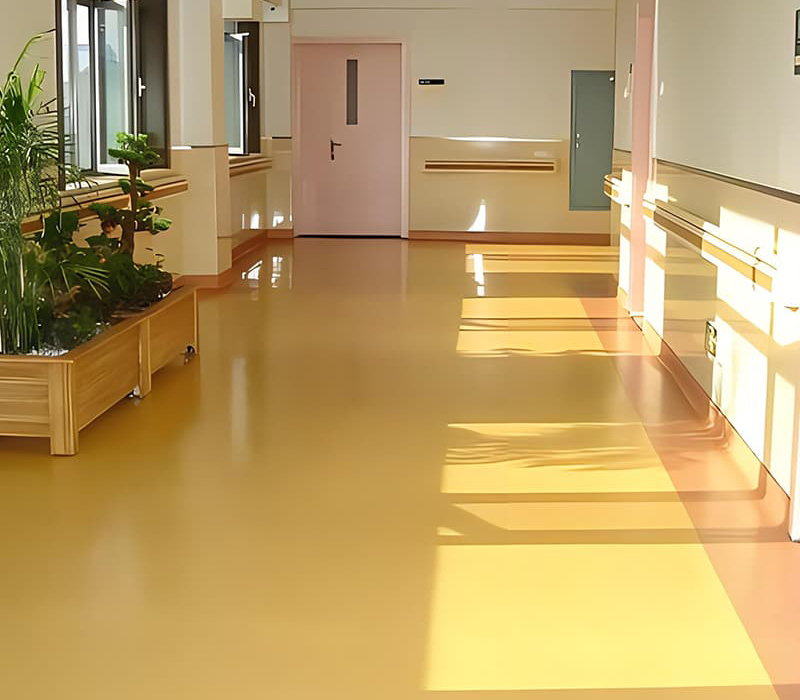
- Vinyl sheet flooring
- Cushioned vinyl flooring
- Roll flooring
- Printed decorative flooring
- Other compatible multilayer flooring structures
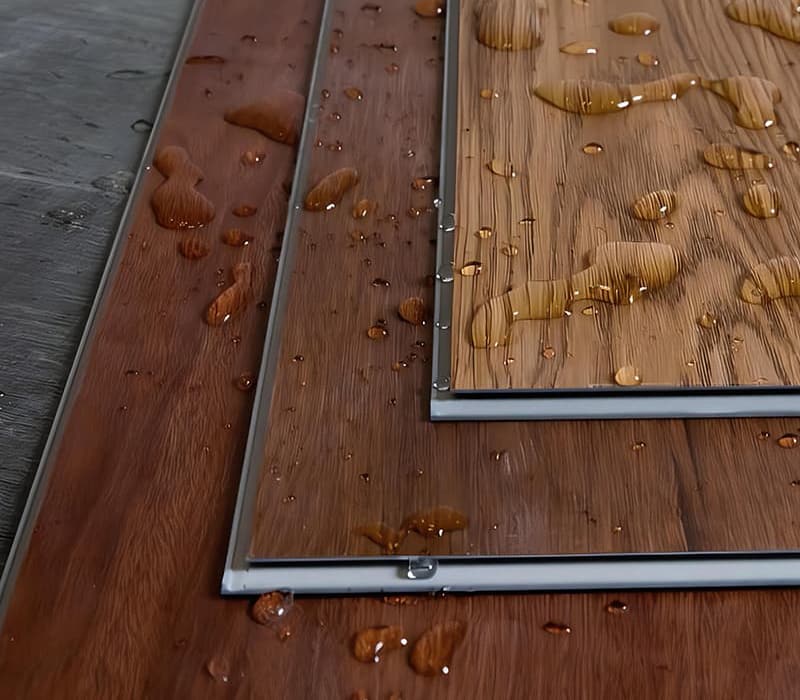
A typical floor may include:
- Surface coating
- Transparent PVC or TPU wear layer
- Printed decorative film
- Intermediate vinyl layer
- Rigid or flexible core
- Balance or backing layer
The exact arrangement varies by flooring category and production process. Some constructions also include foam, reinforcement, acoustic backing, adhesives, or specialized surface coatings.
Film is only one part of the completed floor. Wear behavior, dimensional stability, stain response, indentation, surface appearance, and long-term use are also influenced by the core, lamination quality, embossing, coating, backing, and installation system.
How Flooring Film Functions in a Multilayer Floor
Each layer performs a different task. Distinguishing between the decorative film, wear film, and upper coating makes it easier to define the correct material and processing requirements.
Decorative Print Layer
The printable layer creates the floor’s visible design. Depending on the artwork and printing process, it may reproduce:
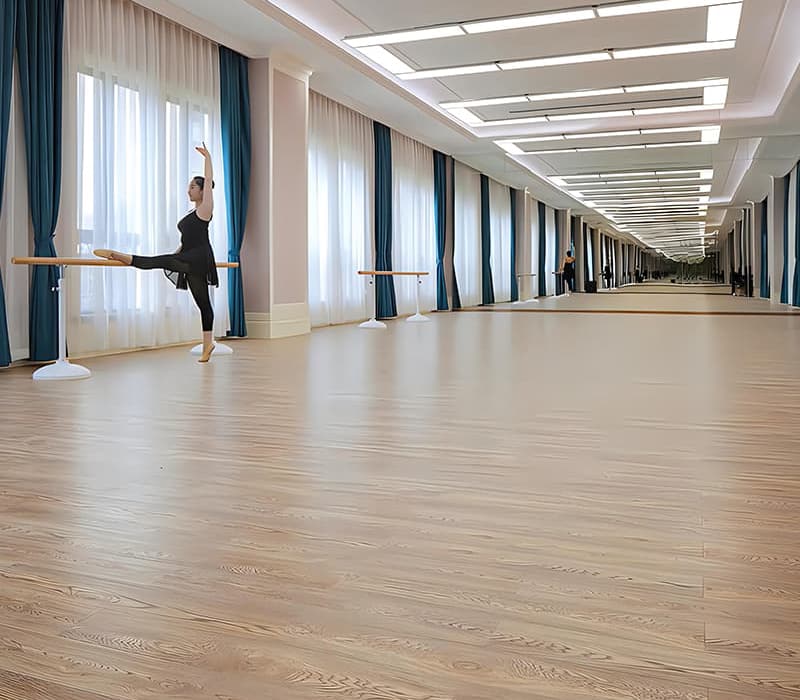
- Wood grain
- Stone and marble
- Concrete
- Terrazzo
- Textile structures
- Geometric patterns
- Abstract graphics
- Solid-color finishes
- Customized decorative themes
A suitable decorative film needs a consistent surface, reliable interaction with ink, controlled dimensional behavior, and compatibility with the following lamination stages.
Transparent Wear Layer
The transparent wear layer is positioned over the printed film. It helps separate the design from direct walking contact, routine cleaning, moving furniture, and abrasive particles brought onto the floor.
Wear-layer behavior is influenced by:
- Polymer formulation
- Film thickness
- Thickness consistency
- Transparency and haze
- Surface coating
- Embossing
- Lamination quality
- Abrasion test method
- Overall flooring construction
Additional thickness can provide more protective material, but it does not independently determine the finished floor’s wear performance.
Surface Coating
Some flooring products receive a coating over the wear layer. Depending on the coating system, it may affect:
- Gloss level
- Stain response
- Scratch response
- Ease of cleaning
- Surface touch
- Interaction with chemicals
The coating and wear layer are separate components. The wear layer is a polymer film built into the flooring structure, while the coating is applied to the uppermost surface.
Core and Supporting Layers
The core supplies structural support. SPC normally uses a rigid mineral-polymer core, whereas LVT often has a flexible or semi-rigid vinyl construction.
Core composition and processing can influence:
- Lamination temperature
- Applied pressure
- Cooling rate
- Dimensional movement
- Surface flatness
- Bonding between layers
As a result, one film may respond differently when paired with different cores, production lines, or layer combinations.
Main Types of PVC/TPU Film for Flooring
MSD’s flooring film range includes decorative printable films and transparent protective films. Each type is developed for a particular position and purpose within the floor.
PVC Printable Film for Vinyl Flooring
PVC printable film forms the decorative layer in compatible vinyl flooring. Its surface is designed to accept printed patterns and remain suitable for later heating and lamination processes.
Important characteristics include:
- Surface consistency
- Controlled base color
- Print definition
- Ink adhesion
- Dimensional response
- Heat compatibility
- Pattern registration
- Lamination behavior
- Roll flatness
For applicable designs, controlled whiteness can support clean color reproduction. The most appropriate base shade still depends on the artwork, ink coverage, target color, and desired appearance after lamination.
PVC Printable Film for SPC and LVT Flooring
Printable film for SPC and LVT is designed for integration into rigid or flexible vinyl-based structures.
The material should be reviewed in relation to:
- Printing temperature
- Web tension
- Pattern precision
- Thermal response
- Dimensional stability
- Lamination pressure
- Cooling behavior
- Embossing compatibility
- Adhesion to adjacent layers
Because SPC and LVT use different core constructions, they may require different film specifications or line settings. A material that runs well in one structure may need adjustment before being introduced into another.
PVC Wear Layer
A PVC wear layer is a clear film positioned over the decorative print. It protects the image from direct contact while allowing the pattern and color to remain visible.
Relevant properties include:
- Optical clarity
- Haze
- Thickness uniformity
- Surface consistency
- Thermal response
- Lamination compatibility
- Abrasion behavior
- Embossing response
- Coating compatibility
PVC wear film is commonly used in vinyl-based flooring because it can be integrated with compatible PVC layers under controlled heat and pressure.
TPU Wear Layer
A TPU wear layer is a transparent thermoplastic polyurethane film used in selected flooring structures. Compared with PVC, it offers a different combination of flexibility, optical properties, mechanical response, and processing behavior.
Important evaluation points include:
- Optical clarity
- Flexibility
- Abrasion response
- Scratch response
- Resilience
- Processing temperature
- Interlayer adhesion
- Surface touch
- Compatibility with the complete floor
TPU is not an automatic substitute for PVC wear film. Its suitability depends on the intended floor structure, processing equipment, lamination method, performance targets, and material configuration.
PVC Flooring Film and TPU Flooring Film
PVC and TPU belong to different polymer families. Their value depends on the role of the film and its compatibility with the intended flooring system.
| Factor |
PVC Flooring Film |
TPU Flooring Film |
| Typical function |
Decorative printable layer or transparent wear layer |
Transparent wear layer in selected constructions |
| Material character |
Flexible material compatible with established vinyl processes |
Flexible polyurethane film with a distinct mechanical profile |
| Printing role |
Commonly used as a decorative print film |
Mainly considered for protective applications |
| Transparency |
Available in clear wear-layer grades |
Available with optical clarity in applicable grades |
| Processing |
Suited to compatible PVC-based structures |
Requires settings appropriate for the selected TPU grade |
| Heat response |
Varies with formulation and thickness |
Varies with polyurethane chemistry and film construction |
| Abrasion response |
Influenced by formulation, thickness, coating, and test conditions |
Influenced by grade, thickness, processing, and complete floor construction |
| Selection basis |
Printability, lamination, protection, and structural compatibility |
Clarity, flexibility, mechanical behavior, and structural compatibility |
Neither material should be evaluated in isolation. Finished-floor performance depends on how the film works with the print layer, coating, core, backing, and production process.
Printable Flooring Film and Decorative Design
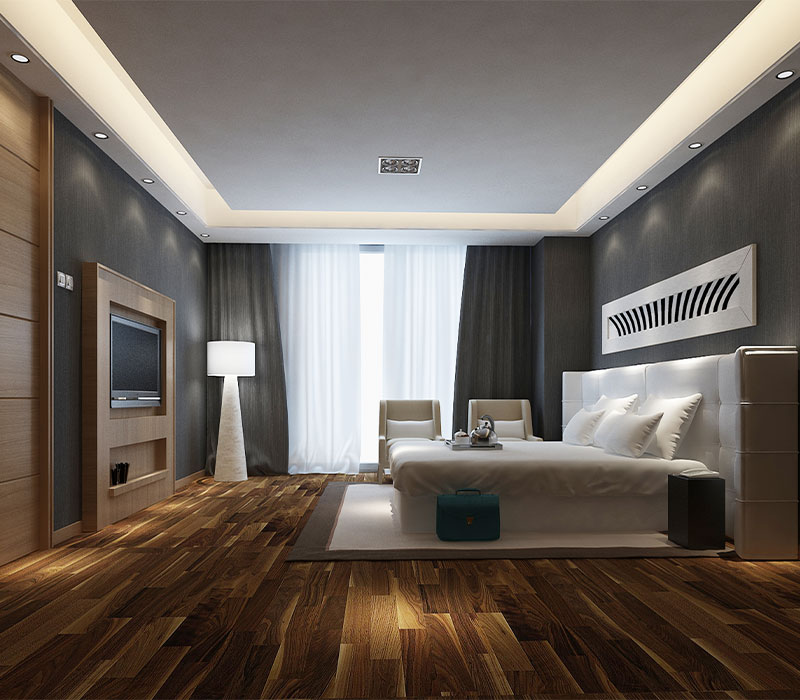
Printable PVC film allows a floor to reproduce many visual themes without using natural wood, stone, or textile as the actual decorative surface.
Wood-Grain Designs
Wood-grain film can present visuals inspired by oak, walnut, pine, ash, maple, and other timber species. Design details may include:
- Grain direction
- Knots
- Saw marks
- Brushed textures
- Natural color variation
- Plank transitions
- Aged or modern finishes
Pattern scale should be coordinated with the finished plank dimensions. Print repeats also need careful planning; highly recognizable knots or grain features can become distracting when they recur too often across the installed floor.
Stone and Mineral Designs
Printable film can reproduce the appearance of:
- Marble
- Slate
- Terrazzo
- Concrete
- Limestone
- Sandstone
- Mineral textures
Tonal transitions, image resolution, pattern scale, and surface embossing all contribute to the perceived depth of the finished design.
Textile and Abstract Designs
Fabric-like structures, linear graphics, geometric forms, and abstract patterns offer alternatives to traditional wood and stone visuals. These styles can support both residential and commercial interior concepts.
The direction and scale of the design should correspond with the final plank, tile, roll, or sheet format.
Color Reproduction
A printed film may change in appearance after it becomes part of the laminated floor. Factors that can influence the final color include:
- Base-film color
- Ink formulation
- Amount of ink coverage
- Surface treatment
- Drying or curing conditions
- Wear-layer transparency
- Wear-layer haze
- Lamination temperature
- Surface coating
- Embossing
- Interior lighting
Color approval should therefore be based on a representative laminated sample, not only on an unlaminated printed film.
Printability of PVC Flooring Film
Printability describes the way a film behaves with the intended ink, printing equipment, web tension, temperature, and drying or curing method.
Ink Adhesion
For reliable printing, the film surface must interact correctly with the chosen ink system. Adhesion may be influenced by surface energy, treatment level, dust, contamination, storage conditions, and ink chemistry.
Settings that work for one ink technology may not produce the same result with another. Compatibility should be established through testing under real production conditions.
Print Definition
A consistent surface supports fine wood grain, narrow lines, subtle tonal transitions, and detailed mineral patterns.
Image definition may be affected by:
- Film flatness
- Surface texture
- Ink spread
- Printing resolution
- Equipment calibration
- Drying or curing
- Web tension
Irregular film feeding or surface variation can reduce sharpness even when the digital artwork is prepared correctly.
Color Uniformity
A controlled base color and consistent film surface help maintain stable printed results. Color should be reviewed across the full working width and, where relevant, between production runs.
Dimensional Behavior During Printing
During printing, the film is exposed to web tension and, in some systems, elevated temperatures. Excessive movement may cause:
- Registration changes
- Pattern distortion
- Width variation
- Wrinkling
- Misalignment during lamination
Line settings should be matched to the selected film construction, thickness, and thermal response.
Printing and Lamination Trial
A combined technical trial can be used to examine:
- Film feeding
- Ink adhesion
- Color reproduction
- Image sharpness
- Pattern registration
- Thermal response
- Drying or curing
- Lamination adhesion
- Visual changes after lamination
- Embossing response
Testing both printing and lamination provides a more realistic view of the final floor than evaluating the printed film alone.
Understanding PVC and TPU Wear Layers
The wear layer helps preserve the printed design, but its actual performance is linked to the complete flooring structure.
What Does a Flooring Wear Layer Do?
A flooring wear layer reduces direct exposure of the decorative image to:
- Walking
- Routine cleaning
- Furniture movement
- Dust and abrasive particles
- General surface contact
It may also provide the surface used for embossing or for applying a subsequent coating.
Does Thickness Determine Wear Performance?
Thickness matters, but it is only one part of the performance equation.
Wear behavior can also be influenced by:
- Polymer formulation
- Thickness uniformity
- Surface coating
- Embossing depth
- Lamination settings
- Type of abrasive material
- Cleaning practices
- Test method
- Complete flooring construction
Two wear films with the same nominal thickness may perform differently because of variations in formulation, coating, lamination, or sample preparation.
Abrasion and Scratching Are Different
Abrasion is the gradual removal or change of a surface through repeated rubbing and contact. Scratching usually involves concentrated contact from a hard or sharp object.
Strong abrasion results do not automatically establish the same level of resistance to scratching, cutting, impact, or indentation. These properties need separate test methods and clearly defined conditions.
Technical Characteristics of PVC/TPU Flooring Film
Material characteristics affect line performance, decorative appearance, layer compatibility, and the behavior of the completed flooring structure.
Transparency and Haze
A transparent wear layer needs to preserve the visibility of the printed design beneath it.
Optical evaluation may include:
- Light transmission
- Haze
- Clarity
- Gloss
- Visible defects
- Color change after lamination
Low haze can support a sharp decorative image. In some surface designs, a controlled level of diffusion may be preferred. The target optical profile should reflect the intended visual effect.
Abrasion Response
Abrasion response is affected by the film formulation, thickness, coating, surface treatment, embossing, and finished-floor construction.
Any stated result should identify the applicable test method, sample structure, load, abrasive medium, and endpoint.
Scratch Response
Scratch behavior should be measured separately from general abrasion. Surface hardness, coating, embossing pattern, contact geometry, and the type of object involved can all change the visible result.
Dimensional Stability
Flooring film may pass through printing, heating, lamination, pressure, cooling, and embossing. Controlled dimensional behavior helps maintain:
- Pattern alignment
- Surface flatness
- Width consistency
- Layer registration
- Stable roll processing
Dimensional movement at one stage can create misalignment or distortion later in production.
Heat Response
Excessive heat may affect:
- Film dimensions
- Transparency
- Surface gloss
- Printed color
- Layer adhesion
- Embossing behavior
Insufficient heat can result in incomplete bonding between otherwise compatible layers. Suitable processing windows should be established through technical trials.
Surface Uniformity
Surface or roll defects may affect printing, optical quality, or lamination. Inspection may include:
- Thickness variation
- Gels and particles
- Bubbles
- Surface marks
- Wrinkles
- Edge quality
- Roll telescoping
- Color variation
- Optical distortion
Inspection priorities should reflect whether the film is intended for printing or for use as a transparent protective layer.
Layer Adhesion
Bonding between the printable film, wear layer, core, and other supporting layers may depend on:
- Surface condition
- Material compatibility
- Temperature
- Pressure
- Processing time
- Cooling method
- Surface coating or treatment
- Storage conditions
Adhesion should be checked after the full production cycle rather than immediately after heating alone.
Embossing Compatibility
Embossing creates texture on the floor surface. Film thickness, flexibility, thermal response, and cooling conditions can influence the sharpness and stability of the embossed pattern.
The process may also alter gloss, haze, and the apparent clarity of the printed design.
PVC/TPU Flooring Film Specifications
The following table outlines key specification areas for PVC and TPU flooring films.
| Specification |
Displayed Range or Type |
Selection Consideration |
| Material |
PVC or TPU |
Match the polymer to the flooring structure and process |
| Film function |
Printable film or wear layer |
Define the layer position before selecting a grade |
| Thickness |
Selected products around 0.07–0.70 mm |
Confirm according to film function and floor design |
| Width |
Selected products up to approximately 4.23 m |
Coordinate with equipment, artwork layout, and finished format |
| Surface |
Printable, transparent, or application-specific |
Review printing, coating, embossing, and lamination needs |
| Base color |
White or another specified appearance |
Assess its effect on the printed design |
| Optical properties |
Transparency, haze, clarity, and gloss |
Evaluate after representative lamination |
| Abrasion performance |
Varies by grade and test conditions |
Review the complete test information |
| Processing behavior |
Printing, lamination, and embossing compatibility |
Conduct trials using the intended layer structure |
The figures above represent selected film constructions within the category. Current thickness, width, optical values, and mechanical properties should be verified for the relevant film grade.
Flooring Applications
PVC and TPU films can be integrated into several flooring categories when the material and processing conditions are compatible.
SPC Flooring
SPC flooring contains a rigid mineral-polymer core. PVC printable film creates the visible design, while a transparent wear layer is positioned over it for protection.
Important considerations include:
- Film flatness
- Printing precision
- Thermal response
- Lamination temperature
- Cooling behavior
- Wear-layer transparency
- Pattern alignment
- Embossing
Because SPC has a rigid core, surface irregularities can remain visible if the layers are not prepared, aligned, and laminated correctly.
LVT Flooring
LVT normally uses a flexible or semi-rigid vinyl construction. Decorative and protective films should work with the product’s heating, lamination, embossing, coating, and finishing processes.
Selection factors may include:
- Tile or plank dimensions
- Decorative repeat
- Wear-layer thickness
- Film flexibility
- Layer adhesion
- Surface coating
- Dimensional response
The film should be tested within the actual LVT structure, as results from another flooring category may not transfer directly.
Vinyl Sheet Flooring
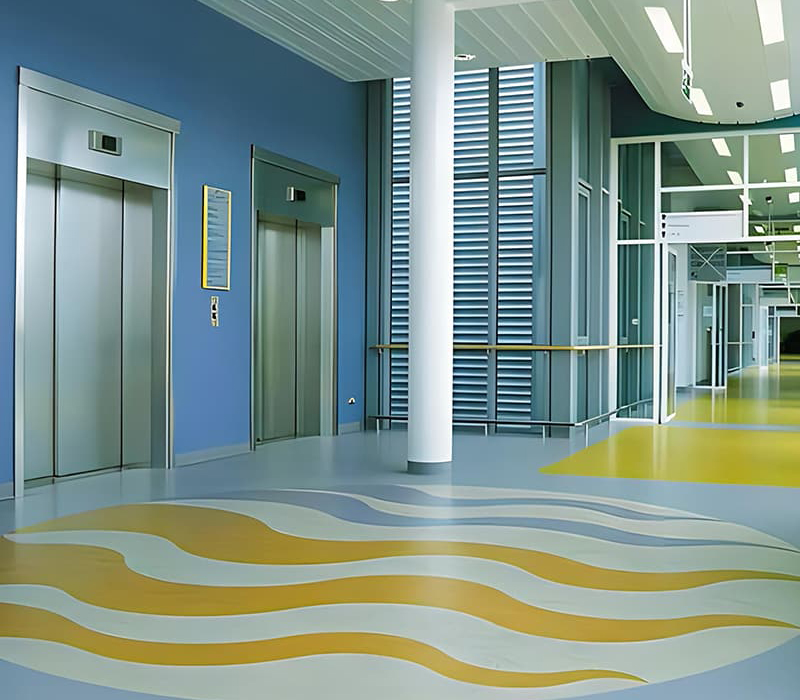
Wide-width printable film can create continuous decorative effects in compatible sheet-flooring products.
Film dimensions and behavior should be coordinated with:
- Printing equipment
- Lamination equipment
- Final sheet width
- Edge trimming
- Pattern layout
- Web tension
Width alone does not guarantee smooth processing. Roll flatness, tension control, thermal movement, and alignment are also important.
Cushioned Vinyl Flooring
Cushioned vinyl flooring may contain foam or other resilient intermediate layers. These materials can respond differently to heat and pressure from rigid flooring cores.
The printable and wear films should therefore be assessed as part of the complete cushioned structure, including its heating, pressing, cooling, and embossing stages.
Commercial Interior Flooring
Floors intended for frequently used interiors may place stronger emphasis on wear-layer design, surface coating, stain response, cleaning compatibility, and dimensional behavior.
Any required performance level should be established through testing of the completed flooring product.
Residential Flooring
Residential flooring may place greater attention on decorative appearance, clarity, surface feel, cleaning convenience, and compatibility with the intended room.
The film contributes to these characteristics, but the finished result still depends on the complete floor construction and installation.
How to Select PVC/TPU Film for Flooring
Film selection should begin by defining where the material sits in the floor. From there, its optical, dimensional, and processing requirements can be matched to the production method.
1. Identify the Film Function
Determine whether the film will be used as:
- A decorative printable layer
- A transparent PVC wear layer
- A transparent TPU wear layer
Each position requires a different balance of printability, transparency, heat response, and mechanical behavior.
2. Confirm the Flooring Type
Identify whether the film will be incorporated into SPC, LVT, vinyl sheet, cushioned vinyl, or another compatible structure.
Core composition and overall flexibility influence how the film behaves during heating, pressing, embossing, and cooling.
3. Review the Complete Layer Structure
Document every layer above and below the film, including:
- Surface coatings
- Adhesive or bonding layers
- Intermediate vinyl layers
- Core materials
- Reinforcement
- Foam
- Backing materials
This makes it easier to identify possible compatibility or adhesion issues before production.
4. Define Processing Conditions
Review the intended:
- Printing technology
- Ink system
- Web tension
- Lamination temperature
- Lamination pressure
- Processing time
- Embossing conditions
- Cooling method
Film evaluation should reproduce these conditions as closely as possible.
5. Select Film Thickness
Thickness should correspond with the film’s function, floor structure, equipment, surface design, and required test methods.
It should not be treated as the only indicator of durability or processing suitability.
6. Confirm Film Width
Film width needs to align with equipment capacity, artwork layout, edge-trimming allowance, and finished flooring dimensions.
The practical working width may differ from the nominal roll width once trimming and process tolerances are included.
7. Evaluate Optical Requirements
For transparent wear film, assess:
- Clarity
- Haze
- Gloss
- Visible particles
- Optical distortion
- Color change after lamination
Evaluation should take place on a representative finished structure wherever possible.
8. Establish Test Methods
Define the methods used to assess:
- Ink adhesion
- Interlayer adhesion
- Abrasion
- Scratch response
- Dimensional stability
- Optical appearance
- Embossing behavior
- Finished-floor performance
Test conditions and acceptance criteria should be documented clearly so that results remain comparable.
Why Choose MSD PVC/TPU Film for Flooring?
MSD develops PVC and TPU films for decorative and protective flooring structures. The category includes PVC printable film, transparent PVC wear layers, and TPU wear layers for compatible SPC, LVT, vinyl sheet, cushioned vinyl, and related flooring products.
Film formulation, calendaring, surface control, optical evaluation, roll inspection, and application development are connected within MSD’s manufacturing system. This allows printing behavior, lamination compatibility, transparency, and mechanical response to be considered together.
Relevant MSD capabilities include:
- PVC printable film development
- Transparent PVC wear-layer production
- TPU wear-layer development
- Wide-width film manufacturing
- Controlled film thickness
- Surface-uniformity management
- Base-color and whiteness evaluation
- Transparency and haze evaluation
- Print-interaction testing
- Lamination compatibility assessment
- Abrasion testing for applicable grades
- Roll and edge inspection
- Application-focused specification development
- Technical documentation for relevant products
MSD also examines how the film responds to printing equipment, ink, web tension, heat, pressure, embossing, cooling, core materials, and surface coatings.
Where a specific abrasion value, optical property, thickness, width, or processing characteristic is required, the corresponding technical information should be reviewed for the selected film grade and test method.
Frequently Asked Questions About PVC/TPU Film for Flooring
These answers cover common questions about PVC printable film, PVC and TPU wear layers, optical properties, thickness, testing, and lamination.
What is the difference between PVC and TPU wear film?
PVC wear film is widely used in compatible vinyl-based flooring structures. TPU wear film is based on thermoplastic polyurethane and has a different processing and mechanical profile.
The appropriate option depends on transparency, flexibility, lamination conditions, surface requirements, adjacent layers, and the design of the completed floor.
Is a thicker wear layer always more abrasion-resistant?
No. Thickness is important, but abrasion performance is also influenced by polymer formulation, film uniformity, surface coating, embossing, lamination, test conditions, and the finished flooring structure.
Films with the same nominal thickness can produce different results.
Can PVC printable film be used for SPC flooring?
Applicable PVC printable film can be used as the decorative layer in SPC flooring. Ink interaction, thermal response, dimensional stability, lamination conditions, and compatibility with the neighboring layers should be tested before full production.
Can flooring film be used in LVT?
Applicable printable and protective films can be incorporated into LVT structures. Film thickness, flexibility, heat response, layer adhesion, embossing, and coating compatibility should match the intended LVT process.
What designs can flooring print film reproduce?
Printable film can reproduce wood grain, marble, stone, terrazzo, concrete, textile structures, geometric graphics, abstract visuals, solid colors, and customized decorative themes.
Image resolution, pattern scale, repeat frequency, and final flooring dimensions should be coordinated during artwork preparation.
Why are transparency and haze important?
Transparency allows the underlying pattern to remain visible. Haze influences the sharpness and diffusion of the image seen through the wear layer.
Both characteristics should be evaluated after lamination because heat, pressure, coating, and embossing may alter the final appearance.
What does Taber abrasion testing measure?
Taber abrasion testing assesses surface wear under rotating abrasive wheels. Results are influenced by the wheel type, applied load, number of cycles, endpoint, surface coating, film thickness, and sample construction.
A reported cycle value should therefore be read together with the complete test conditions.
Can Taber cycles be converted into years of floor use?
No dependable direct conversion is available. Real flooring use varies with traffic volume, footwear, dust, cleaning methods, furniture movement, maintenance, and environmental conditions.
Taber results are useful for controlled comparison under a defined method, not as a precise prediction of service years.
What film thickness is available?
Selected products in this category are presented within an approximate thickness range of 0.07–0.70 mm. Available thickness depends on whether the material is a printable film, PVC wear layer, or TPU wear layer.
How wide is MSD flooring film?
Selected MSD flooring films are presented in widths reaching approximately 4.23 metres. Available width depends on the material type, thickness, film grade, and current production specifications.
PVC/TPU Film for Flooring links decorative imaging with surface protection in compatible multilayer floors. PVC printable film creates the visible wood, stone, textile, geometric, or customized design. Transparent PVC or TPU wear film sits above the print and helps reduce direct contact with the decorative image.
The suitability of a flooring film cannot be determined by polymer type or thickness alone. Print response, transparency, haze, heat behavior, layer adhesion, embossing, coating, cooling, core construction, and production settings all contribute to the final floor.
Evaluating the material as part of the complete structure provides a clearer basis for defining film specifications, production conditions, inspection criteria, and finished-floor testing across SPC, LVT, vinyl sheet, cushioned vinyl, and related flooring applications.
MSD — PVC Printable Film, PVC Wear Layers, and TPU Wear Layers for Compatible Decorative Flooring Structures.

 English