Artistic Ceiling Film (PVC) for Decorative and Illuminated Ceilings
Artistic Ceiling Film (PVC) gives designers greater freedom to shape how a ceiling looks, feels, and interacts with light. Instead of relying on heavy, rigid ceiling finishes, this flexible membrane can create clean flat surfaces, flowing curves, printed features, translucent panels, and large illuminated areas.
MSD develops and manufactures PVC stretch ceiling film, PVC artistic film, and PVC translucent film for homes, hotels, retail interiors, offices, cultural venues, schools, healthcare facilities, and public buildings. The membrane can be integrated with suitable profiles, lighting equipment, ventilation elements, access components, and decorative frames to create a coordinated ceiling system.
Each design places different demands on the material. Printed ceilings need clear image reproduction and stable color. Illuminated ceilings depend on suitable light transmission and diffusion. Curved features require a membrane with appropriate flexibility, supported by a profile structure designed for the intended shape.
Material selection should therefore reflect the complete project. Important factors include film thickness, available width, finish, tensile behavior, installation temperature, lighting layout, ceiling geometry, and required technical documentation.
What Is Artistic Ceiling Film (PVC)?
Artistic Ceiling Film (PVC) is a flexible polyvinyl chloride membrane created for decorative ceilings and interior surface applications. The membrane is fitted into a compatible profile system, where controlled tension produces a smooth and continuous finish.
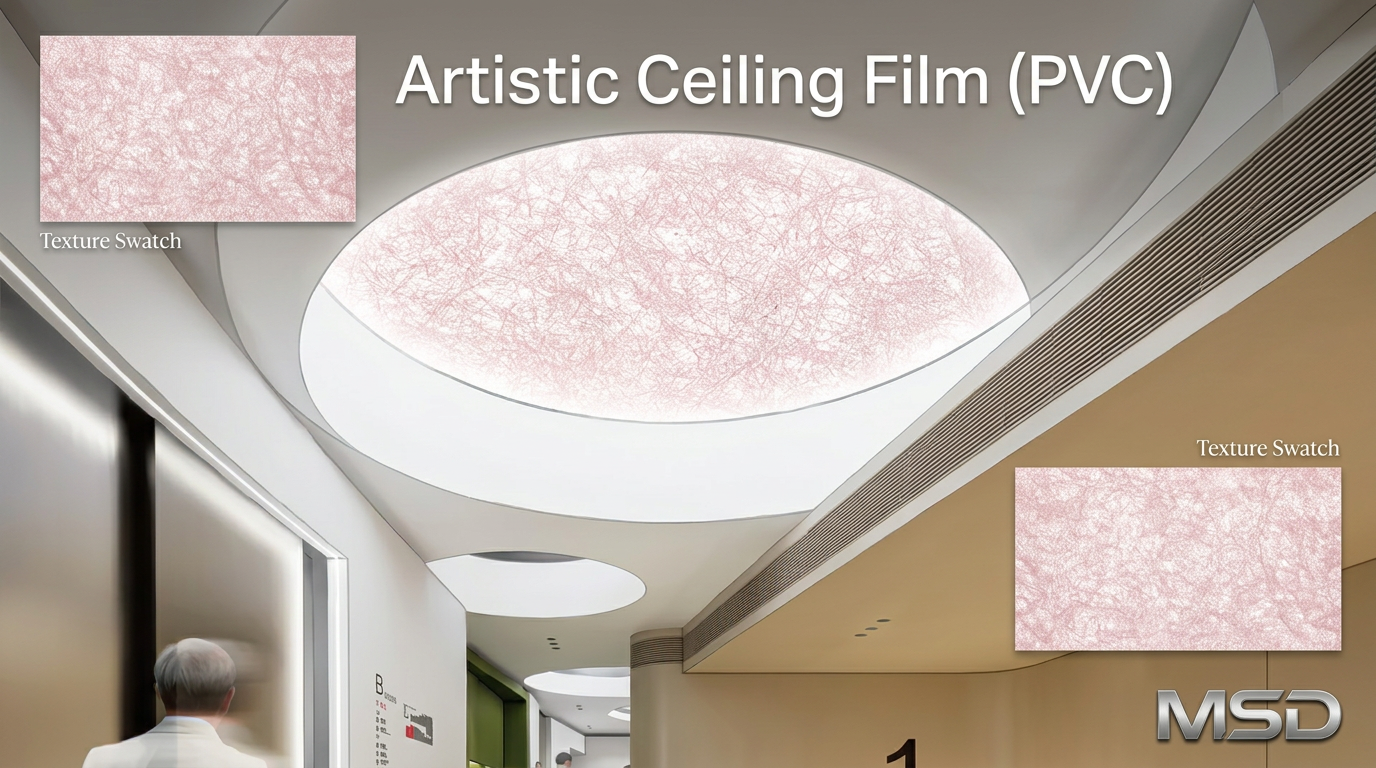
Compared with rigid panels, PVC ceiling film offers more freedom for flat, recessed, curved, multi-level, and selected three-dimensional structures. Depending on the design, its surface may be matte, satin, glossy, translucent, printed, or produced in a solid color.
A complete artistic ceiling system may contain:
- PVC ceiling film
- Perimeter profiles
- Fixing accessories
- Lighting equipment
- Ventilation openings
- Maintenance access points
- Reinforcement for lamps and fixtures
- Suspension or supporting frames
The membrane is only one element of the completed ceiling. Accurate site measurements, suitable profiles, room conditions, lighting placement, installation methods, and ongoing care all influence the final appearance and service performance.
Artistic ceiling film can be incorporated into new buildings or renovation projects. Its low weight is particularly useful when an interior needs a fresh decorative surface without the bulk associated with many rigid materials.
Main Types of Artistic Ceiling Film
The MSD Artistic Ceiling Film range covers three main material groups: PVC stretch ceiling film, PVC artistic film, and PVC translucent film. Although they share a flexible PVC base, each serves a distinct design or lighting purpose.
PVC Stretch Ceiling Film
PVC stretch ceiling film is tensioned inside a compatible profile system to form a neat finished surface. Once fitted, it can conceal an unfinished structural ceiling, electrical wiring, pipes, ventilation parts, and selected technical services.
Common applications include:
- Flat ceilings
- Recessed features
- Curved structures
- Multi-level ceiling designs
- Decorative ceiling sections
- Ceilings with integrated lighting
- Refurbishment of existing surfaces
The finished ceiling is influenced by the membrane’s flexibility, dimensions, response to controlled heating, profile configuration, and applied tension.
Wide-format film can help reduce visible joins in suitable rooms. The actual layout, however, depends on the room size, film width, ceiling shape, fixture positions, and fabrication plan.
PVC Artistic Film
PVC artistic film is intended for spaces where the ceiling plays an active visual role. It can carry custom graphics, decorative motifs, gradual color transitions, abstract compositions, or themed imagery.
Design possibilities include:
- Geometric forms
- Botanical imagery
- Sky and cloud scenes
- Stone-style textures
- Abstract illustrations
- Cultural themes
- Architectural graphics
- Brand-focused visuals
- Color gradients
- Coordinated wall and ceiling designs
A printed ceiling can become a central interior feature rather than simply filling the space above a room.
Several details affect the quality of the completed graphic:
- Source image resolution
- Final artwork size
- Printing scale
- Color profile
- Base film color
- Surface gloss
- Interior lighting
- Normal viewing distance
- Placement of the image
Artwork should be prepared using the real ceiling dimensions. A small, low-resolution file may lose sharpness or show pixelation when enlarged across a wide surface.
PVC Translucent Film
PVC translucent film allows controlled light passage while softening the appearance of individual lamps. It is commonly used for luminous ceilings, backlit features, decorative light boxes, and illuminated wall or ceiling structures.
Typical uses include:
- Full-area luminous ceilings
- Illuminated ceiling panels
- Recessed light features
- Decorative light boxes
- Retail display lighting
- Hotel and restaurant lighting concepts
- Exhibition installations
- Combined wall and ceiling light features
The film alone cannot guarantee even illumination. The visible result is shaped by:
- Light transmission level
- Film color
- Surface finish
- Distance between lamps and membrane
- Lamp spacing
- Light output
- Color temperature
- Reflection inside the cavity
- Cavity depth
- Colors of nearby surfaces
Where brightness, color consistency, or uniform illumination is critical, a project-scale lighting trial can reveal issues that may not be visible from a small, unlit sample.
Technical Characteristics of PVC Ceiling Film
Artistic ceiling film combines visual flexibility with practical material properties. These characteristics should always be considered as part of the completed ceiling system rather than viewed in isolation.
Flexibility and Formability
PVC ceiling film can follow flat surfaces, recessed sections, curves, and selected three-dimensional forms. Its forming behavior depends on formulation, thickness, temperature, applied tension, and structural geometry.
A complex ceiling with tight curves may need a different material response from a simple rectangular surface. Profiles and supporting components must also suit the intended shape.
Lightweight Ceiling Surface
Compared with many rigid ceiling materials, PVC film creates a lightweight finished surface. This can be valuable in refurbishment work or decorative projects where unnecessary structural load is best avoided.
Even with a lightweight membrane, profiles, fixings, and support frames must be selected to suit the room dimensions and installation conditions.
Smooth Visual Appearance
With accurate fabrication and installation, stretch ceiling film forms a clean surface under controlled tension.
Its appearance may be influenced by:
- Wall alignment
- Profile position
- Membrane tension
- Location of fixtures
- Room temperature
- Ceiling dimensions
- Surface finish
- Direction of light
Strong directional light can highlight small variations, especially on highly reflective glossy finishes.
Moisture-Resistant Surface
PVC film has low water absorption and provides a surface that resists moisture under suitable interior conditions.
This does not mean that every completed ceiling functions as a fully sealed waterproof barrier. Lamps, vents, access panels, perimeter connections, and other openings can affect the system’s overall response to moisture.
Leaks or condensation above the membrane should be identified and corrected promptly.
Dimensional Stability
Controlled formulation and film production help maintain suitable dimensions during fabrication and fitting.
Material behavior may also change with:
- Storage temperature
- Installation temperature
- Heating technique
- Applied tension
- Room size
- Film thickness
- Conditions inside the finished space
The film should be stored, transported, and handled in line with the relevant material guidance.
Surface Cleanability
The smooth PVC surface can usually be maintained with gentle cleaning methods. A soft, clean cloth and a mild compatible cleaning solution are generally preferable to rough tools or abrasive products.
Any cleaning chemical should first be checked on a small, inconspicuous area. Strong solvents, sharp objects, and abrasive pads may damage the print, alter the gloss, or mark the membrane.
Light Transmission and Diffusion
Translucent ceiling film can soften emitted light and reduce the visibility of individual lamps behind the surface.
Light transmission refers to the quantity of light that passes through the membrane. Light diffusion describes how that light spreads across the visible area. The two characteristics are connected, but they measure different aspects of lighting performance.
Brightness and uniformity should be assessed with the intended lamps, spacing, color temperature, and cavity depth.
Decorative Printing
Printed film supports detailed graphics, repeating patterns, gradients, and themed interior concepts. Ceiling artwork can also be coordinated with walls, floors, furniture, signs, and lighting features.
Print durability is affected by the printing system, surface construction, cleaning method, light exposure, and conditions within the room.
Fire Performance
Certain buildings and interior spaces require a stated reaction-to-fire classification. Any such performance must be supported by documentation covering the selected film model, thickness, construction, and test method.
A report for one membrane version should not automatically be applied to a different finish, thickness, or material composition.
Artistic Ceiling Film Specifications
PVC ceiling film specifications should be reviewed in relation to the ceiling design, supporting structure, lighting concept, and installation method.
Specification
| Thickness |
Affects handling, flexibility, and fitting response |
Match it with the product series and ceiling structure |
| Width |
Influences surface planning and visible joins |
Compare available width with the room dimensions |
| Length |
Affects fabrication and material planning |
Check the relevant product model |
| Surface finish |
Changes reflection, appearance, and care needs |
Select matte, satin, glossy, printed, or translucent film |
| Light transmission |
Influences brightness in backlit ceilings |
Assess it with the planned light source |
| Light diffusion |
Affects visible lighting uniformity |
Test with the intended lamp spacing and cavity depth |
| Color |
Changes interior coordination and perceived light tone |
View samples beneath the planned illumination |
| Print resolution |
Determines detail and image clarity |
Prepare the artwork at a suitable final scale |
| Tensile behavior |
Influences fabrication and installation |
Match the membrane with the ceiling geometry |
| Fire classification |
May relate to building compliance |
Verify the exact model and supporting report |
Selected products currently shown on the MSD website include film thicknesses of approximately 0.18 mm and 0.22 mm, with certain widths reaching 3.2 metres. Roll length differs between product models.
These values apply to selected materials, not the entire Artistic Ceiling Film range. Current technical data should be checked against the relevant product specification.
Where Is Artistic Ceiling Film Used?
Artistic ceiling film is suitable for a broad range of residential, commercial, cultural, educational, healthcare, and public interiors. Material choice should reflect the room’s purpose, expected lighting, cleaning needs, ceiling geometry, and applicable building standards.
Residential Interiors
Residential applications may include:
- Living rooms
- Bedrooms
- Dining areas
- Hallways
- Kitchens
- Bathrooms with suitable ventilation
- Home entertainment rooms
- Decorative lighting areas
Matte finishes produce a subtle, restrained appearance. Glossy surfaces add reflection and visual depth. Printed membranes create focal points, while translucent film allows the ceiling to become part of the lighting design.
Hotels and Hospitality Spaces
Ceiling film may be used in:
- Hotel lobbies
- Guest rooms
- Corridors
- Restaurants
- Cafés
- Reception areas
- Function rooms
- Leisure spaces
Hospitality interiors often depend on close coordination between ceiling finishes, furniture, lighting, and wall treatments. Maintenance access for lamps and technical services should be included in the design before the membrane is fitted.
Retail Spaces and Showrooms
Printed and translucent ceiling film can support:
- Illuminated display areas
- Themed graphics
- Seasonal visual features
- Brand-related designs
- Directional ceiling elements
- Product lighting
- Decorative ceiling zones
Viewing height and movement through the space should be considered during artwork preparation. Very fine details may be difficult to see from floor level, particularly beneath a high ceiling.
Offices
Office applications may include:
- Reception areas
- Meeting rooms
- Shared workspaces
- Staff break areas
- Corridors
- Presentation rooms
- Decorative light features
The lighting plan should balance brightness, visual comfort, screen use, and the reflective behavior of the selected membrane.
Cultural and Exhibition Spaces
Artistic ceiling film can be incorporated into museums, galleries, cinemas, exhibition halls, and creative venues.
Printed surfaces can reinforce a theme or guide visitors through a space. Translucent membranes can provide soft illumination for circulation areas and exhibits. Light intensity, glare, and color rendering should be considered in relation to the displayed objects.
Educational and Public Interiors
Suitable ceiling films may be used in schools, universities, libraries, civic buildings, and public service areas.
Where fire behavior, indoor emissions, or other regulated properties are specified, supporting documents should correspond to the selected membrane and local requirements.
Healthcare and Wellness Interiors
Smooth ceiling surfaces and diffused lighting can contribute to calm surroundings in clinics, treatment rooms, wellness centres, and related interiors.
Performance descriptions should remain tied to verified evidence. Medical, antibacterial, or hygiene-related statements require specific test documentation.
Artistic Ceiling Film and Lighting Integration
Lighting integration is one of the most distinctive uses of translucent PVC ceiling film. A balanced result depends on the relationship between the membrane, lamps, cavity, internal surfaces, and maintenance plan.
Backlit Ceiling Design
In a backlit ceiling, lamps sit above the translucent membrane. The film hides the lighting equipment while spreading light across the visible surface.
The cavity needs sufficient depth for the light to mix before it reaches the membrane. A shallow cavity may increase the risk of bright spots, shadows, or visible lamp outlines.
Lamp Spacing
Lamp spacing has a direct effect on lighting uniformity. Wide gaps can leave dark areas, while lamps positioned too close to the film may create concentrated bright points.
A suitable layout depends on:
- Lamp type
- Beam angle
- Light output
- Cavity depth
- Film transmission
- Diffusion characteristics
- Ceiling dimensions
- Color Temperature
Warm, neutral, and cool light sources change the apparent color of the membrane.
For example, neutral white film can take on a cream tone beneath warm lighting or appear slightly blue beneath a cool source. Samples should therefore be assessed using the planned color temperature rather than daylight alone.
Heat Management
Lighting equipment generates heat. Lamp type, ventilation, cavity design, and distance from the membrane should keep operating temperatures within a range compatible with the ceiling system.
Maintenance Access
Lamps, drivers, wiring, and other components may require inspection or replacement. Access points should be included in the ceiling plan while keeping them visually discreet and practical to use.
Installation of PVC Artistic Ceiling Film
Installing artistic ceiling film calls for precise measurement, suitable profiles, careful site preparation, and controlled fitting techniques.
A typical installation process includes these stages:
- Site assessment
The room dimensions, walls, ceiling height, corners, fixtures, and service locations are examined.
- Ceiling layout
The ceiling height, shape, transitions, lighting sections, openings, and maintenance access points are defined.
- Profile installation
Compatible profiles are attached around the perimeter or fitted to the supporting decorative structure.
- Lighting and service preparation
Wiring, lamps, ventilation parts, reinforcement pieces, and structural elements are prepared before the membrane is fitted.
- Film preparation
The membrane is fabricated to suit the dimensions, geometry, and selected fitting system.
- Membrane installation
The film is secured within the profiles using controlled tension and the appropriate installation technique.
- Fixture treatment
Openings around lamps, vents, sprinklers, access points, and other components are reinforced and finished.
- Final inspection
Alignment, surface tension, appearance, transitions, fixtures, and perimeter details are checked.
Installation time varies with room size, ceiling complexity, site access, fixture quantity, working conditions, and the experience of the installation team.
How to Select Artistic Ceiling Film
Choosing artistic ceiling film starts with the desired visual result, but technical compatibility is equally important. The membrane, profiles, lighting, room geometry, and documentation should be assessed as one connected system.
Define the Ceiling Concept
First, identify the intended result:
- A soft matte surface
- A reflective glossy ceiling
- Printed artwork
- A translucent luminous ceiling
- A solid-color finish
- A curved feature
- A multi-level structure
Review the Room Dimensions
Room width, length, ceiling height, corners, columns, and recessed areas affect film layout, profile placement, fabrication, and the position of visible joins.
Confirm the Supporting System
The chosen membrane must work with the profiles, fixing accessories, lighting equipment, supporting frame, and decorative structure used in the project.
Select the Surface Finish
Matte film offers limited reflection and a calm appearance. Glossy film provides stronger reflections and greater visual depth. Translucent film is suited to lighting applications, while printed film turns the ceiling into a decorative focal point.
Evaluate Thickness and Flexibility
Thickness should be reviewed alongside formulation, tensile response, installation method, and ceiling geometry. A thicker membrane is not necessarily the best choice for every design.
Plan the Lighting
For translucent applications, evaluate lamp type, spacing, output, beam angle, color temperature, cavity depth, internal reflection, and future maintenance access.
Check Technical Documentation
When a project specifies fire classification, tensile properties, indoor emission limits, or another measured characteristic, review documents for the exact product model and relevant test standard.
Assess a Material Sample
Physical samples help reveal color, gloss, texture, translucency, and print quality. For a luminous ceiling, a small lighting mock-up provides more practical information than viewing the membrane without backlighting.
Care and Maintenance of Artistic Ceiling Film
Appropriate maintenance helps retain the appearance of PVC ceiling film and reduces the risk of accidental surface damage.
Recommended practices include:
- Use a clean, soft cloth.
- Choose a mild, non-abrasive cleaning solution that is compatible with PVC.
- Keep sharp tools away from the membrane.
- Avoid strong solvents unless compatibility has been verified.
- Remove marks gently without applying concentrated pressure.
- Inspect lamps and access components during scheduled maintenance.
- Correct leaks and condensation sources promptly.
- Follow care guidance for the selected finish.
Glossy membranes tend to show wiping marks more readily than matte surfaces. Cleaning cloths and tools should always be free from dust, grit, and abrasive particles.
Why Choose MSD Artistic Ceiling Film?
MSD has worked with PVC film materials since 2002. Its Artistic Ceiling Film range includes PVC stretch ceiling film, PVC artistic film, and PVC translucent film for smooth, curved, printed, decorative, and illuminated interior surfaces.
Material formulation, continuous film production, surface development, decorative printing, and product inspection are managed through an integrated manufacturing system. This allows visual goals and technical properties to be considered together rather than treated as separate concerns.
MSD capabilities include:
- PVC film formulation
- Continuous film manufacturing
- Thickness and width control
- Wide-format ceiling film
- Matte and glossy surface development
- Translucent film development
- Decorative pattern printing
- Color and finish evaluation
- Roll-condition inspection
- Application-focused specification development
- Technical documentation for applicable product models
MSD also evaluates how the membrane will interact with room dimensions, ceiling profiles, light placement, fixture openings, structural shapes, and installation conditions.
Where a project requires defined fire performance, tensile characteristics, or emission limits, the supporting documents should be checked for the selected film construction.
Frequently Asked Questions About Artistic Ceiling Film
This section addresses practical questions about PVC ceiling film, printed membranes, translucent surfaces, dimensions, maintenance, and technical performance.
What types of artistic ceiling film does MSD manufacture?
MSD manufactures PVC stretch ceiling film, PVC artistic film, and PVC translucent film. Each material supports a different mix of decorative, forming, printing, and lighting functions.
Can PVC ceiling film be printed?
Yes. Suitable PVC ceiling film can be printed with images, patterns, gradients, illustrations, and customized graphics. Source resolution, final scale, surface finish, lighting, and viewing distance all affect the completed result.
Can translucent PVC film be used for a luminous ceiling?
Yes. Translucent PVC film can form the visible surface of a luminous ceiling. Lamp spacing, light output, cavity depth, film transmission, diffusion, and color temperature determine how evenly the ceiling is illuminated.
Can artistic ceiling film follow a curved structure?
Suitable flexible film can follow curved surfaces and selected three-dimensional forms. The profiles, supporting structure, fabrication plan, and fitting method must be compatible with the intended geometry.
Is PVC ceiling film waterproof?
PVC film has low water absorption and creates a moisture-resistant surface. However, a completed ceiling also contains profiles, fixtures, vents, openings, and access components. Its overall moisture performance depends on the entire system.
Does artistic ceiling film have a fire classification?
Fire performance varies with film composition, thickness, finish, and test method. Any required classification should be verified through documentation for the exact product model.
What thickness is available?
Selected MSD products are presented in thicknesses of approximately 0.18 mm and 0.22 mm. Availability varies by film series and intended use.
How wide is MSD artistic ceiling film?
Selected products shown on the MSD website reach widths of up to 3.2 metres. Current width and roll dimensions should be confirmed through the relevant technical data.
How is artistic ceiling film cleaned?
Use a soft cloth with a compatible, non-abrasive cleaning solution. Rough pads, sharp tools, and aggressive solvents should be avoided because they may mark the surface or affect the printed finish.
Is artistic ceiling film suitable for renovation?
Yes. PVC ceiling film can create a new decorative surface beneath an existing ceiling in suitable renovation projects. Walls, profiles, overhead services, fixtures, and site conditions should be assessed before installation begins.
Artistic Ceiling Film (PVC) brings material flexibility, decorative expression, and lighting design into a single ceiling concept. Stretch ceiling film produces clean, smooth surfaces. Artistic film introduces customized imagery and patterns. Translucent film supports softly illuminated ceilings and architectural light features.
A successful installation depends on more than the membrane alone. Profiles, room dimensions, supporting structures, lamps, fixtures, access points, and fitting conditions must work together. Reviewing these elements as a complete system helps create a ceiling that is visually balanced, practical to maintain, and appropriate for its surroundings.
MSD — PVC Stretch Ceiling Film, Artistic Film, and Translucent Film for Decorative Interior Applications.

 English