Drop Stitch and Airtight Inflatable Materials in PVC, TPU and CPU
Drop Stitch and Airtight Inflatable Materials are reinforced flexible composites designed for sealed air chambers and structures supported by internal pressure. Depending on the application, the construction may combine three-dimensional drop stitch textiles, woven reinforcement, PVC, TPU or CPU surfaces, airtight polymer layers, flexible sidewalls, and materials prepared for compatible joining processes.
MSD develops drop stitch composites, airtight inflatable fabrics, and related materials for stand-up paddle boards, boats, kayaks, mattresses, floating platforms, training mats, and other inflatable products. The appropriate construction depends on the intended shape, internal pressure, textile design, polymer system, fabrication method, environmental exposure, and dimensions of the finished structure.
Drop stitch composites and conventional airtight fabrics perform different tasks. Internal connecting yarns allow drop stitch material to maintain a controlled thickness after inflation. Conventional airtight fabric is better suited to tubes, curved chambers, rails, sidewalls, and flexible forms. Many inflatable products combine both materials.
Material Definitions and Structural Principles
A clear distinction between drop stitch composites and conventional airtight fabric makes it easier to define the structure, surface system, and fabrication route for an inflatable product.
What Are Drop Stitch and Airtight Inflatable Materials?
Drop Stitch and Airtight Inflatable Materials are textile-reinforced composites used to create sealed chambers and structural components that take shape through air pressure.
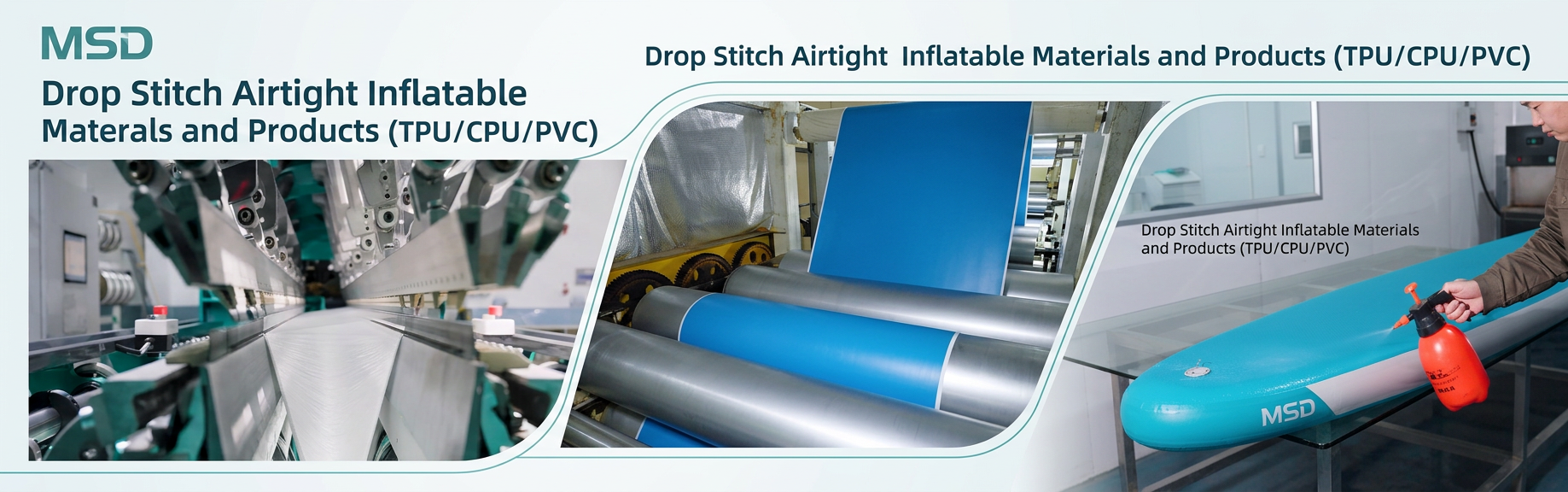
This category may include:
- PVC drop stitch inflatable material
- TPU drop stitch material
- CPU drop stitch material
- PVC airtight fabric for inflatable boats
- Inflatable mattress material
- Rail and sidewall material
- Air-chamber fabric
- Reinforcement patches
- Valve attachment material
- Coated or laminated inflatable composites
Drop stitch constructions contain a dense network of yarns connecting two opposite textile surfaces. Conventional airtight fabric does not contain this internal yarn structure. Its inflated shape is created through panel design, seams, internal dividers, and the geometry of the complete chamber.
These materials are normally supplied as semi-finished components. Finished performance is also influenced by:
- Panel dimensions
- Sidewall structure
- Seam design
- Valve selection
- Local reinforcement
- Fabrication settings
- Accessory installation
- Operating pressure
- Temperature
- Load distribution
- Cleaning and storage
For this reason, technical data for the material should not be presented as a complete performance rating for the finished inflatable product.
What Is Drop Stitch Material?
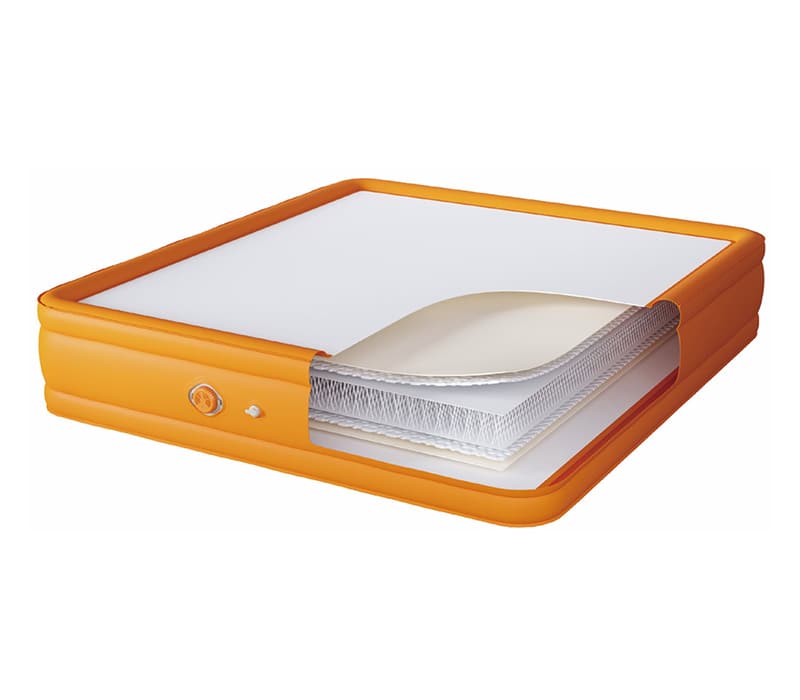
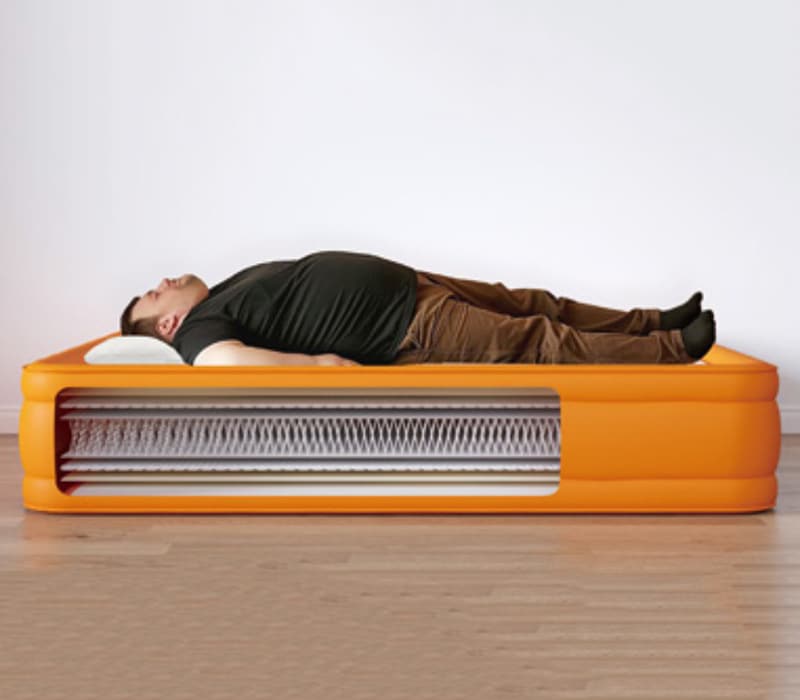
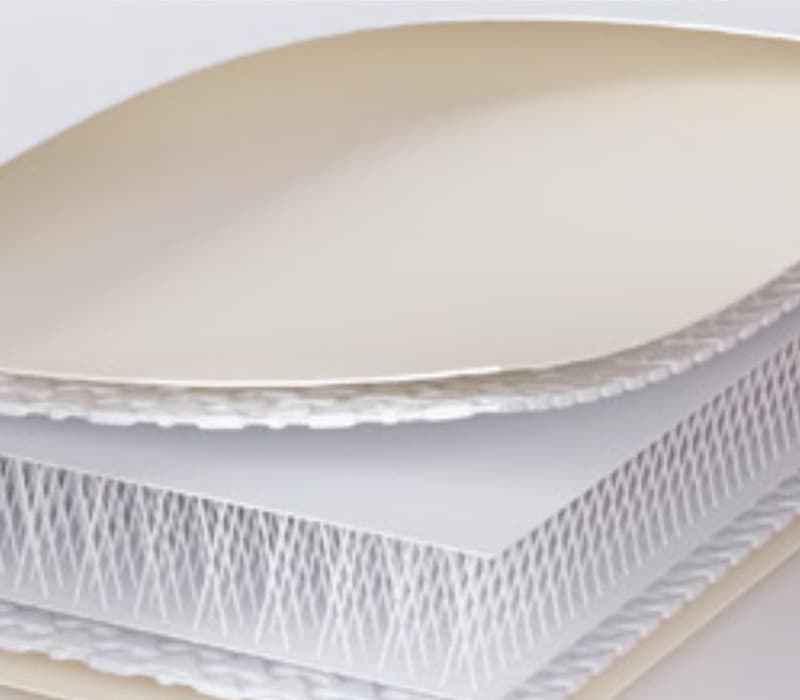
Drop stitch material is a three-dimensional textile composite made from two parallel fabric layers connected by numerous internal yarns. When the completed chamber is inflated, these yarns restrict outward expansion, helping the structure maintain a defined thickness and a relatively flat profile.
A typical construction contains:
- Upper textile layer
- Lower textile layer
- Internal connecting yarns
- Coated or laminated outer surfaces
- Perimeter sidewall material
- Welded or adhesively bonded seams
- Valves and reinforced attachment areas
Connecting-yarn length plays an important role in determining inflated thickness. Yarn density, pattern, and attachment consistency affect load transfer, dimensional control, and the appearance of the inflated surface.
Drop stitch material is commonly used for:
- Inflatable paddle boards
- Floating docks
- Inflatable platforms
- Watercraft floors
- Gymnastics and training mats
- Air-supported panels
- Selected mattress constructions
- Inflatable furniture components
The material itself does not establish the safe working pressure of a completed structure. Sidewalls, seams, valves, product size, environmental temperature, reinforcement, and safety design must also be assessed.
What Is Airtight Inflatable Fabric?
Airtight inflatable fabric is a textile-reinforced composite with a coated or laminated polymer surface that limits air transmission through the base textile.
Unlike drop stitch material, conventional airtight fabric normally has no yarn network connecting opposing surfaces. It can therefore be cut and fabricated into curved, tubular, chambered, or pattern-defined forms.
Typical uses include:
- Inflatable boat tubes
- Kayak side chambers
- Mattress air chambers
- Drop stitch sidewalls
- Inflatable arches
- Flexible cushions
- Air-supported furniture
- Reinforcement patches
- Valve mounting areas
- Curved inflatable components
The term airtight fabric describes the material’s intended air-retaining role. It does not mean that every fabricated chamber will remain completely free from pressure loss. Seams, valves, accessory connections, surface damage, and manufacturing consistency all affect the completed structure.
Drop Stitch Material vs. Airtight Inflatable Fabric
The two materials can complement each other, but they create different inflated forms and require different structural evaluations.
| Feature |
Drop Stitch Material |
Airtight Inflatable Fabric |
| Internal structure |
Two textile surfaces connected by internal yarns |
Reinforced fabric without yarns linking opposing surfaces |
| Inflated geometry |
Controlled thickness and comparatively flat surfaces |
Tubular, curved, or pattern-shaped chambers |
| Structural function |
Pressure-supported panels, decks, floors, and platforms |
Flexible chambers, rails, tubes, and sidewalls |
| Typical applications |
Paddle boards, docks, training mats, and watercraft floors |
Boat tubes, mattresses, cushions, and perimeter rails |
| Main controls |
Yarn geometry, textile structure, outer surfaces, and perimeter seams |
Textile reinforcement, airtight surface, chamber geometry, and seams |
| Fabrication approach |
Panel cutting, perimeter closure, reinforcement, and valve installation |
Pattern cutting, panel joining, chamber formation, and valve installation |
| Evaluation focus |
Thickness control, rigidity, yarn consistency, and pressure response |
Air retention, flexibility, seam behavior, and chamber shape |
An inflatable paddle board, for example, may use drop stitch material for its central body and conventional airtight fabric for the rails, attachment areas, and reinforcement patches.
How Does Drop Stitch Material Work?
Air pressure inside a sealed drop stitch chamber pushes the upper and lower surfaces apart. As the chamber expands, the connecting yarns become tensioned. Their controlled length limits further separation and helps preserve the intended thickness.
Inflated geometry and rigidity can be affected by:
- Connecting-yarn length
- Yarn density
- Yarn arrangement
- Yarn attachment consistency
- Upper and lower textile construction
- Outer polymer layers
- Product length and width
- Inflated thickness
- Sidewall geometry
- Seam width and location
- Internal pressure
- Temperature
- Type and position of the load
Pressure is only one part of structural performance. A broad floating platform carrying a concentrated load may behave differently from a smaller panel inflated to the same pressure.
Temperature should also be considered. Heating can increase internal pressure, while colder conditions may reduce pressure and alter material flexibility. Validation should reflect the environment in which the finished product will be used.
Components of an Inflatable Material System
Each component contributes to the behavior of the complete air-supported structure.
| Component |
Primary Function |
Key Evaluation Points |
| Internal yarns |
Control spacing between the two drop stitch surfaces |
Length, density, alignment, tension, and attachment stability |
| Textile reinforcement |
Carries loads beneath the polymer surface |
Fabric structure, tensile response, tear behavior, and dimensional stability |
| Airtight surface layer |
Limits air transmission and supports fabrication |
Thickness, flexibility, adhesion, and joining response |
| Sidewall or rail |
Closes the perimeter of a drop stitch panel |
Corner flexibility, width, reinforcement, and seam compatibility |
| Seam |
Connects panels and seals the chamber |
Seam geometry, fabrication settings, strength, and leakage |
| Valve |
Controls inflation and deflation |
Position, sealing, flow, and pressure compatibility |
| Reinforcement |
Spreads concentrated loads |
Location, patch geometry, layer structure, and attachment method |
Changing one component may affect several other characteristics. A heavier outer layer may alter packability and joining settings, while a different yarn length changes inflated thickness and finished geometry.
Polymer Systems, Manufacturing and Technical Performance
PVC, TPU, and CPU offer different approaches to creating air-retaining surfaces on textile reinforcement. Their suitability depends on the precise chemistry, layer structure, thickness, manufacturing route, and expected service environment.
PVC Inflatable Material
PVC inflatable materials combine textile reinforcement with a PVC coating, laminated PVC film, or another compatible PVC surface construction. Depending on the grade, the material can provide color, printability, flexibility, air retention, and compatibility with selected welding or bonding methods.
Technical evaluation may include:
- PVC formulation
- Plasticizer system
- Surface-layer thickness
- Bonding between PVC and textile
- Welding response
- Sensitivity to heat
- Low-temperature flexibility
- Water exposure
- Blocking tendency
- Color consistency
- Migration requirements
- Relevant chemical documentation
PVC constructions are used for drop stitch surfaces, inflatable boat fabrics, mattress chambers, sidewalls, rails, and reinforcement parts.
The term PVC does not represent one fixed performance level. Formulation, textile construction, layer thickness, surface finish, and fabrication conditions can vary considerably between grades.
TPU Inflatable Material
TPU inflatable materials use thermoplastic polyurethane film or an application-specific TPU surface integrated with textile reinforcement.
Depending on the construction, TPU can provide a different balance of:
- Flexibility
- Surface feel
- Mechanical behavior
- Layer thickness
- Low-temperature response
- Welding characteristics
- Abrasion response
- Finished weight
- Hydrolysis response
Important technical variables include:
- Polyurethane chemistry
- Film thickness
- Textile-to-film bonding
- Lamination conditions
- Welding temperature range
- Thermal response
- Humidity exposure
- Repeated folding
- Surface marking
- Expected environmental conditions
TPU is a broad material family. Different polyurethane chemistries may respond differently to heat, moisture, sunlight, and long-term use. Any performance statement should therefore identify the precise material construction and test method.
CPU Inflatable Material
Where CPU refers to a cast polyurethane system, it describes a polyurethane surface formed through a controlled coating or casting process.
Evaluation may consider:
- Polyurethane chemistry
- Coating thickness
- Casting or coating uniformity
- Curing conditions
- Bonding to the textile
- Flexibility
- Thermal behavior
- Hydrolysis response
- Joining method
- Surface appearance
- Response to repeated folding
Because CPU can have different meanings in other industries, product documentation should state the intended definition and describe the relevant construction clearly.
PVC vs. TPU vs. CPU Inflatable Materials
No single polymer system is automatically the best choice for every inflatable application. The material should be compared within the complete structure and intended fabrication process.
| Material System |
Typical Integration Route |
Evaluation Priorities |
| PVC |
Coating, lamination, or another compatible surface-integration method |
Formulation, textile adhesion, thermal response, and seam formation |
| TPU |
Film lamination or application-specific coating |
Polyurethane chemistry, bonding, welding range, and hydrolysis response |
| CPU |
Cast or coated polyurethane system where applicable |
Curing, coating uniformity, adhesion, and joining compatibility |
Polymer names alone do not predict the behavior of a finished product. Textile structure, surface thickness, seam method, component geometry, environmental exposure, and process control remain equally important.
Structure of Drop Stitch and Airtight Materials
The construction combines reinforcement, air-retaining surfaces, and application-specific structural elements.
Internal connecting yarns
Internal yarns give drop stitch material its three-dimensional character. Their controlled length helps define inflated thickness, while yarn density and distribution influence load transfer and surface consistency.
Relevant variables include:
- Yarn material
- Yarn count
- Yarn length
- Yarn density
- Yarn pattern
- Tension consistency
- Attachment stability
- Fatigue response
Irregular yarn geometry may cause local thickness differences, uneven loading, or visible deformation after inflation.
Inflated samples are useful for inspection because some structural variation may not be obvious while the material remains compressed in roll form.
Textile reinforcement
The textile provides mechanical support beneath the polymer surface.
Evaluation may include:
- Woven, knitted, or application-specific construction
- Yarn specification
- Fabric density
- Tensile behavior
- Tear response
- Dimensional stability
- Surface consistency
- Thermal behavior
- Coating or lamination compatibility
The textile is not normally airtight on its own. Air retention depends on the polymer surface, sidewalls, seams, valve installation, and the integrity of the completed chamber.
Airtight polymer layer
The polymer layer limits air movement through the textile and provides a surface for compatible fabrication.
Its functions may include:
- Air retention
- Surface protection
- Color
- Printing
- Welding
- Adhesive bonding
- Cleaning
- Water contact
- Abrasion response
Thickness, formulation, and layer uniformity can affect joining, flexibility, packability, and surface durability.
Sidewalls and rails
Sidewalls connect the upper and lower surfaces around the perimeter of a drop stitch panel. They need enough flexibility to follow corners while maintaining stable seams.
Sidewall performance can be influenced by:
- Polymer system
- Textile reinforcement
- Material width
- Layer thickness
- Corner geometry
- Seam construction
- Fabrication settings
- Inflation frequency
Complex corners and transitions may require a different sidewall design from straight panel sections.
Reinforcement components
Valves, handles, fins, seats, rings, straps, and attachment points create local stresses. These areas may require additional layers, larger patches, wider seams, or geometry that distributes force across a broader area.
Reinforcement should be evaluated as part of the complete attachment detail. A patch can be strong while the transition around its edge remains vulnerable to concentrated stress.
How Are Drop Stitch and Airtight Inflatable Materials Manufactured?
Production generally combines textile preparation, three-dimensional structural formation where applicable, polymer integration, stabilization, finishing, inspection, and roll preparation.
Textile and yarn preparation
Yarn specifications, textile density, feeding tension, alignment, and surface condition are managed before coating or lamination.
For drop stitch structures, control points may include:
- Connecting-yarn length
- Yarn distribution
- Yarn alignment
- Upper and lower textile consistency
- Usable width
- Surface flatness
Stable yarn feeding is important because irregularities may affect inflated thickness and surface shape later in fabrication.
Three-dimensional textile formation
The upper and lower textile layers are formed together with the internal connecting yarns. This textile geometry becomes the structural basis of the inflated panel.
Before inflation, the material remains flexible and compressed. Its full three-dimensional form appears after polymer integration, perimeter sealing, valve installation, and inflation.
Control may focus on:
- Distance between textile surfaces
- Yarn attachment
- Yarn-length consistency
- Textile density
- Width stability
- Surface uniformity
- Visible structural variation
Coating or lamination
PVC, TPU, CPU, or another compatible polymer system is integrated with the textile reinforcement.
Processing variables may include:
- Textile preparation
- Surface treatment
- Polymer-layer thickness
- Application uniformity
- Temperature
- Pressure
- Line speed
- Curing conditions
- Cooling
- Layer adhesion
- Surface finish
Uniform processing across the working width supports consistent joining behavior, appearance, dimensions, and air-retaining performance.
Stabilization
Controlled curing, cooling, or conditioning may be required to develop the intended adhesion and dimensional behavior.
The applicable method depends on the polymer chemistry, layer structure, and manufacturing process. Inadequate stabilization may contribute to curling, internal stress, surface variation, or inconsistent bonding.
Surface finishing
Depending on the grade, the surface may be:
- Smooth
- Textured
- Colored
- Printable
- Gloss-adjusted
- Prepared for a compatible joining process
Surface finish can affect printing, cleaning, abrasion response, grip, and the appearance of fabricated seams.
Inspection and roll preparation
Inspection may include:
- Material width
- Total thickness
- Area weight
- Surface-layer consistency
- Internal yarn distribution
- Visible defects
- Color consistency
- Layer adhesion
- Edge quality
- Roll geometry
- Dimensional response
Winding tension and roll pressure should be controlled. Excessive or uneven pressure may create wrinkles, edge deformation, surface marks, or roll-shape problems.
Technical Properties of Inflatable Materials
Test data should always identify the specimen. A base textile, coated composite, welded joint, sealed chamber, and completed inflatable product represent different levels of evaluation.
Tensile strength
Tensile strength describes how the textile or finished composite responds to pulling force under stated conditions.
Results can vary with:
- Test direction
- Specimen dimensions
- Test speed
- Conditioning
- Textile construction
- Polymer layers
- Test method
Because reinforced textiles may behave differently in each principal direction, data should identify the tested orientation.
Tensile strength is useful for material comparison, but it does not directly establish the safe pressure of a completed inflatable structure.
Tear resistance
Tear resistance describes how existing damage progresses through a material. It is distinct from tensile strength, puncture response, seam strength, and abrasion.
Separate evaluation may be necessary around:
- Panel edges
- Valve openings
- Handles
- Attachment areas
- Hardware openings
- Corners
- Reinforcement boundaries
These details may concentrate force within a relatively small section of material.
Peel adhesion
Peel adhesion evaluates the connection between the textile and its coated or laminated surface.
Results may be influenced by:
- Polymer chemistry
- Textile preparation
- Process temperature
- Pressure
- Curing
- Sample conditioning
- Heat aging
- Water exposure
- Test direction
- Test speed
The reported result should identify which layers were separated and how the specimen was prepared.
Initial adhesion and conditioned adhesion may differ. Water, humidity, heat, and repeated folding can be included where they reflect the intended application.
Air permeability and air retention
Air permeability usually refers to material-level testing. Air retention refers to the ability of a joint, chamber, or complete structure to hold pressure for a defined period.
Possible leakage paths include:
- Material surface
- Welded seams
- Adhesively bonded seams
- Valves
- Attachment areas
- Damaged sections
A low material-permeability value cannot replace seam testing or pressure-hold evaluation on a representative chamber.
Air-retention data should state the initial pressure, temperature, test duration, measurement method, and acceptance criteria.
Seam strength
Seam performance is influenced by:
- Polymer surface
- Textile construction
- Joining method
- Seam width
- Temperature
- Pressure
- Dwell time
- Cooling or curing
- Load direction
- Environmental conditioning
Fabrication settings developed for one polymer, thickness, or textile construction should not automatically be used for another.
Seams should also be assessed at corners, transitions, and reinforced areas, not only as straight test strips.
Pressure response
Pressure testing can reveal dimensional changes, local deformation, seam behavior, leakage, valve response, and structural stability.
A useful test statement identifies:
- Test specimen
- Product dimensions
- Inflated thickness
- Test pressure
- Hold time
- Temperature
- Acceptance criteria
- Safety procedure
Material pressure data and finished-product working pressure are not interchangeable. Safe working conditions depend on the entire structure and its intended use.
Abrasion response
Abrasion testing measures surface change caused by repeated rubbing.
Results depend on:
- Abrasive medium
- Applied load
- Number of cycles
- Surface construction
- Test endpoint
- Sample conditioning
Abrasion data should be linked to the stated method and exact material surface. It should not be treated as proof of puncture, cut, or impact resistance.
Low-temperature flexibility
Cold conditions can influence flexibility, folding, surface appearance, layer adhesion, and seam response.
Relevant data should identify:
- Material grade
- Exposure temperature
- Exposure time
- Conditioning method
- Evaluation procedure
Testing may include visual inspection, bending, folding, or seam assessment after cold exposure.
Hydrolysis response
For polyurethane systems, hydrolysis behavior depends on polymer chemistry, humidity, temperature, and exposure duration.
TPU and CPU should not be treated as single, uniform chemistries. Supporting data should correspond to the specific construction under consideration.
Weathering response
Sunlight, heat, humidity, and temperature cycling may affect:
- Color
- Flexibility
- Surface gloss
- Layer adhesion
- Dimensional stability
- Mechanical behavior
Outdoor suitability should be supported by information for the selected material grade and expected exposure. A general indoor grade should not automatically be considered appropriate for prolonged outdoor or marine use.
Fabrication, Applications and Material Selection
Fabrication connects the material specification with the completed inflatable product. Cutting, printing, welding, bonding, valve installation, and reinforcement should be validated with representative materials and production equipment.
Cutting and Panel Preparation
Accurate cutting helps maintain panel dimensions, seam positions, symmetry, and the intended inflated geometry.
A cutting plan should consider:
- Material direction
- Usable width
- Panel dimensions
- Seam allowance
- Valve position
- Attachment areas
- Reinforcement
- Printed graphics
- Edge condition
Clean edges can reduce local defects that may develop into tears during joining, inflation, or use.
Cut panels should be checked before fabrication for dimensional consistency, edge separation, surface damage, and correct orientation.
Printing
Applicable surfaces may support compatible printing methods for graphics, instructions, identification marks, or decorative designs.
A print trial may evaluate:
- Ink adhesion
- Color appearance
- Image definition
- Curing conditions
- Surface flexibility
- Water exposure
- Cleaning response
- Repeated folding
- Influence on seam areas
Printing should be positioned carefully around valves, seams, handles, folds, and reinforcement patches.
Ink or coating should be kept away from critical joining areas unless compatibility has been demonstrated through representative seam testing.
High-Frequency Welding
Selected PVC constructions may support compatible high-frequency welding. Suitability depends on the PVC formulation, polymer-layer thickness, textile reinforcement, electrode design, and machine settings.
Evaluation may include:
- Seam appearance
- Seam width
- Joining strength
- Heat marks
- Layer distortion
- Air retention
- Process repeatability
- Corner formation
Seams should be checked after cooling and suitable conditioning. Immediate visual appearance does not provide a complete assessment of joint strength or leakage.
Hot-Air and Thermal Welding
Applicable thermoplastic surfaces, including selected TPU constructions, may support hot-air or thermal welding.
Process development should consider:
- Surface chemistry
- Heat input
- Air temperature
- Travel speed
- Roller pressure
- Seam overlap
- Cooling
- Finished seam appearance
Excessive heat can distort the polymer layer or damage the textile. Insufficient heat may produce incomplete bonding. A stable process window should be established through trials.
Adhesive Bonding
Some surfaces, accessories, sidewalls, or reinforcement components may use an application-specific adhesive system.
Bonding performance can depend on:
- Surface cleaning
- Surface preparation
- Adhesive chemistry
- Application quantity
- Open time
- Contact pressure
- Curing
- Temperature
- Water exposure
- Direction of loading
Representative joints should be evaluated after suitable conditioning. Straight peel samples may be supplemented with corner, patch, and attachment tests where those details are relevant.
Valve and Accessory Installation
Valves, handles, fins, seats, rings, straps, and other attachment points should be integrated through reinforced structures designed for their expected loads.
These areas may require evaluation of:
- Patch dimensions
- Layer arrangement
- Surface preparation
- Joining method
- Direction of load
- Leakage
- Repeated use
- Local deformation
Valve installation should be checked for sealing, accessibility, flow, and possible stress around the opening.
Applications of Drop Stitch and Airtight Inflatable Materials
The materials can be combined in many inflatable structures, with each component selected according to geometry, pressure, load, and environmental exposure.
Stand-up paddle boards
Drop stitch material can form the principal pressure-supported body of an inflatable paddle board. Sidewall materials, deck layers, fins, handles, valves, and attachment patches are added during fabrication.
Evaluation should consider:
- Board dimensions
- Inflated thickness
- Surface construction
- Rail design
- Valve location
- Fin attachment
- Handle reinforcement
- Water exposure
- Temperature
- Intended pressure
Board rigidity and stability depend on the complete structure. Width, thickness, outline, internal pressure, rail construction, and load position all contribute to behavior on the water.
The areas around fins, valves, handles, and deck attachments may require dedicated reinforcement and testing.
Inflatable kayaks and boats
Drop stitch panels may be used for floors or selected structural sections, while conventional airtight fabric forms tubes, curved chambers, rails, and side structures.
Important factors include:
- Chamber geometry
- Buoyancy design
- Sidewall seams
- Abrasion exposure
- Water contact
- Valve arrangement
- Seat and handle attachment
- Applicable safety requirements
The material combination should be evaluated within the complete watercraft design. Floor behavior, chamber interaction, reinforcement, and attachment details can influence overall performance.
Inflatable rafts
Materials intended for raft structures should be assessed for:
- Water exposure
- Repeated impact
- Surface abrasion
- Seam construction
- Valve integration
- Floor attachment
- Handles and accessory connections
- Environmental conditions
Material-level tests provide useful information but cannot replace evaluation of the complete raft construction.
Floating docks and platforms
Drop stitch composites can create broad, relatively flat floating surfaces.
Finished behavior depends on:
- Platform length and width
- Inflated thickness
- Internal pressure
- Load distribution
- Connection points
- Surface texture
- Sidewall structure
- Seam design
- Repeated water exposure
Large platforms may require full-size or representative structural trials because small samples cannot reproduce every geometry-related effect.
Inflatable mattresses
Conventional airtight fabric can form flexible chambered mattresses. Selected drop stitch constructions can also be used where controlled thickness and a flatter surface are required.
Evaluation may include:
- Chamber layout
- Surface feel
- Repeated loading
- Seam position
- Valve placement
- Folding behavior
- Storage method
- Indoor temperature range
Comfort and stability depend on chamber design, pressure, textile construction, and load distribution as well as the surface material.
Gymnastics and training mats
Drop stitch material can create training surfaces with adjustable pressure and controlled thickness.
The completed mat should be assessed for:
- Length, width, and thickness
- Surface friction
- Inflation setting
- Rebound response
- Seam placement
- Edge construction
- User load
- Intended activity
Safety and performance testing should reflect the actual use, installation surface, user group, and applicable requirements.
Pressure changes can alter firmness and rebound. The recommended inflation method should therefore be clearly defined for the finished product.
Air-supported furniture
Applicable materials can be used for inflatable benches, beds, tables, seats, and temporary furniture components.
Stability depends on:
- Product geometry
- Internal pressure
- Position of the load
- Floor contact
- Seam design
- Reinforcement
- Attachment components
- Surface friction
- Concentrated loading near corners or edges should be considered separately from evenly distributed weight.
How to Select Drop Stitch and Airtight Inflatable Materials
Selection should begin with the intended structure and continue through polymer choice, geometry, fabrication, environmental exposure, and representative testing.
1. Define the required structure
Determine whether the application needs:
- A flat pressure-supported panel
- A curved air chamber
- A tubular structure
- A perimeter sidewall
- A reinforcement component
- A combination of these elements
This establishes whether drop stitch material, conventional airtight fabric, or a mixed construction is appropriate.
2. Select the polymer system
Evaluate PVC, TPU, or CPU according to:
- Fabrication method
- Required flexibility
- Surface weight
- Environmental exposure
- Joining process
- Heat response
- Water contact
- Repeated folding
- Applicable technical documentation
The polymer should be considered as part of the textile composite, not as an isolated material name.
3. Establish product geometry
Define:
- Length
- Width
- Inflated thickness
- Chamber shape
- Corner radius
- Sidewall configuration
- Valve position
- Attachment points
Geometry affects stress distribution, stiffness, seam layout, surface shape, and pressure response.
4. Define pressure conditions
Pressure assessment should include:
- Intended working pressure
- Inflation method
- Temperature-related pressure change
- Hold time
- Validation procedure
- Deflation method
- Safety controls
Any validation pressure should be clearly distinguished from the normal operating range of the finished structure.
5. Review loading
Relevant load conditions may include:
- Static load
- Dynamic load
- Distributed load
- Concentrated load
- Repeated loading
- Impact
- Stress at attachment points
The same total load can create very different structural effects depending on how and where it is applied.
6. Confirm the joining method
The selected material should be tested with the planned welding or adhesive process.
Representative seam samples should reproduce:
- Intended seam width
- Overlap geometry
- Temperature
- Pressure
- Dwell time
- Surface preparation
- Cooling or curing
- Environmental conditioning
Critical details such as corners, valves, rails, and reinforcement patches should also be included where relevant.
7. Evaluate the service environment
Consider:
- Indoor or exterior use
- Freshwater or saltwater
- Sunlight exposure
- Elevated temperatures
- Low temperatures
- Humidity
- Cleaning
- Folding frequency
- Storage duration
- Contact with other materials
Environmental conditions may affect flexibility, adhesion, color, surface appearance, seams, and internal pressure.
8. Produce a representative trial
A representative sample should include the structural features that create the greatest technical demands.
The trial may include:
- Sidewalls
- Seams
- Valves
- Reinforced attachments
- Printed areas
- Corners
- Inflation
- Pressure hold
- Dimensional checks
Testing only a flat material specimen may not reveal fabrication risks associated with the finished geometry.
Specification Framework
The following framework can help define a drop stitch or conventional airtight construction.
| Specification Area |
What to Define |
Why It Matters |
| Material type |
Drop stitch or conventional airtight fabric |
Establishes the structural role |
| Polymer system |
PVC, TPU, or CPU where applicable |
Influences fabrication and environmental response |
| Textile construction |
Yarn type, textile structure, and density |
Supports mechanical behavior |
| Width |
Usable material width |
Affects panel layout and seam planning |
| Total thickness |
Composite thickness |
Influences handling, weight, and joining |
| Inflated thickness |
Distance between drop stitch surfaces |
Influences geometry and rigidity |
| Area weight |
Mass per unit area |
Affects handling and finished-product weight |
| Surface finish |
Smooth, textured, colored, or printable |
Influences appearance, grip, cleaning, and fabrication |
| Joining method |
Welding or adhesive process |
Establishes processing compatibility |
| Mechanical data |
Tensile, tear, seam, and adhesion results |
Supports comparison under stated test methods |
| Environmental data |
Heat, cold, water, humidity, and light response |
Connects the material with expected service conditions |
Values should be verified using the technical data for the selected MSD construction.
Quality Control, MSD Capabilities and FAQs
Quality control should distinguish clearly between the base textile, polymer-coated composite, fabricated seam, sealed chamber, and complete inflatable structure.
Quality Control for Inflatable Materials
Inspection and testing may include:
- Material width
- Total thickness
- Area weight
- Inflated thickness
- Connecting-yarn distribution
- Yarn attachment condition
- Surface appearance
- Color consistency
- Coating or lamination uniformity
- Layer adhesion
- Tensile strength
- Tear resistance
- Air permeability
- Dimensional response
- Thermal response
- Low-temperature flexibility
- Hydrolysis response where applicable
- Print compatibility
- Welding response
- Adhesive-bonding response
- Seam strength
- Pressure-hold behavior
- Edge quality
- Roll condition
Test documentation should identify whether the specimen is:
- Base textile
- Coated or laminated composite
- Drop stitch material sample
- Welded seam sample
- Adhesively bonded seam sample
- Sealed air chamber
- Completed inflatable product
This distinction reduces the risk of treating a material-level test result as a finished-product rating.
Inspection priorities should reflect the intended application. Yarn geometry and inflated thickness may be critical for a drop stitch platform, while flexibility and seam response may receive more attention for a curved boat chamber.
Storage and Handling
Appropriate storage and handling help preserve surface condition, roll geometry, layer adhesion, and fabrication response.
Recommended practices include:
- Store rolls in a clean, dry area.
- Protect materials from direct sunlight and excessive heat.
- Keep surfaces free from dust, oil, and moisture.
- Prevent sharp objects from contacting material edges.
- Use suitable equipment when moving rolls.
- Retain roll identification and material direction.
- Avoid stacking conditions that may deform the rolls.
- Keep unused material in protective packaging.
- Allow suitable conditioning before processing where required.
- Inspect surfaces and edges before cutting.
- Follow the storage guidance for the selected grade.
Material that has been stored in very hot or cold conditions may need time to reach the processing environment before cutting, printing, welding, or bonding begins.
Why Choose MSD Drop Stitch and Airtight Inflatable Materials?
MSD develops Drop Stitch and Airtight Inflatable Materials with attention to textile reinforcement, internal yarn geometry, polymer integration, layer adhesion, dimensional consistency, and joining compatibility.
The category includes constructions for inflatable watercraft, stand-up paddle boards, mattresses, floating platforms, training equipment, furniture, and related air-supported products. MSD assesses each material as part of the intended inflatable system rather than as an isolated fabric layer.
Relevant MSD capabilities include:
- Drop stitch textile development
- Airtight inflatable-fabric development
- Internal connecting-yarn control
- Textile-reinforcement management
- PVC surface integration
- TPU film or coating integration
- CPU coating development where applicable
- Coating and lamination control
- Thickness and width management
- Layer-adhesion evaluation
- Surface and color inspection
- Print-compatibility assessment
- Welding-response evaluation
- Dimensional-stability assessment
- Roll and edge inspection
- Application-focused material development
- Technical documentation for relevant constructions
MSD also considers how textile geometry, polymer surfaces, sidewalls, seams, valves, reinforcements, and product dimensions interact after fabrication and inflation.
Where a defined pressure condition, polymer system, thickness, joining method, or mechanical value is required, the supporting information should correspond to the selected material construction and stated test method.
Frequently Asked Questions
What are Drop Stitch and Airtight Inflatable Materials?
They are textile-reinforced composites used to create sealed chambers and pressure-supported structures.
Drop stitch material contains internal yarns connecting two opposing surfaces. Conventional airtight fabric has no comparable internal yarn network and is used to form flexible, curved, tubular, or chambered shapes.
What is the difference between drop stitch material and inflatable boat fabric?
Drop stitch material uses internal connecting yarns to maintain a controlled thickness and comparatively flat surface.
Inflatable boat fabric normally forms tubes, side chambers, rails, and other curved or pattern-defined sections. Some watercraft combine drop stitch floors with conventional airtight chambers.
Is drop stitch material airtight?
Air retention depends on the complete construction. The polymer surfaces, sidewalls, seams, valves, reinforcement details, and fabrication process all contribute.
A representative sealed chamber provides more useful air-retention information than an unjoined material sample alone.
What are PVC, TPU and CPU inflatable materials?
They are textile composites made with different polymer surface systems.
Their behavior depends on the precise polymer chemistry, textile reinforcement, surface thickness, adhesion, joining process, environmental exposure, and finished-product design.
What does CPU mean in inflatable materials?
Where confirmed in the product specification, CPU can refer to a cast polyurethane surface system.
Because the abbreviation may have other meanings, the corresponding technical documentation should state the intended definition and describe the material construction.
Can one inflatable product use both drop stitch and airtight fabric?
Yes. Drop stitch material can form a flat structural body, deck, floor, or platform. Conventional airtight fabric can form rails, tubes, curved chambers, sidewalls, and reinforcement sections.
Combining the two allows each material to perform the role best suited to its structure.
Can these materials be welded?
Compatible constructions may support high-frequency, hot-air, thermal, or another validated joining method.
Suitability depends on polymer chemistry, surface thickness, textile structure, equipment, seam design, temperature, pressure, dwell time, and cooling conditions.
Does a thicker surface layer always provide greater pressure capability?
No. Surface thickness is only one variable.
Textile construction, internal yarn geometry, layer adhesion, seams, dimensions, sidewalls, valves, and fabrication quality also affect pressure response.
Can drop stitch material be used for inflatable mattresses?
Yes, selected drop stitch constructions can help control mattress thickness and surface shape.
Conventional airtight fabric can also be used for mattress designs based on flexible internal chambers. The suitable approach depends on comfort, geometry, pressure, packability, seams, and intended use.
Can inflatable materials be printed?
Applicable surfaces may support compatible printing methods.
Testing should examine ink adhesion, curing, flexibility, water exposure, cleaning response, repeated folding, and possible effects on welding or adhesive-bonding areas.
Drop Stitch and Airtight Inflatable Materials combine textile reinforcement, polymer surface technology, and air-chamber fabrication. Drop stitch structures use internal yarns to control thickness and support relatively flat forms. Conventional airtight fabrics create tubes, rails, sidewalls, curved chambers, and reinforcement components.
Reliable material selection requires the entire inflatable system to be reviewed. Textile construction, PVC, TPU or CPU surfaces, sidewalls, seams, valves, reinforcement, pressure, geometry, loading, fabrication settings, and environmental exposure all influence finished performance.
MSD develops drop stitch and airtight inflatable material systems for paddle boards, boats, kayaks, mattresses, floating platforms, training equipment, inflatable furniture, and related air-supported applications.

 English